This article is written by Soma Mukherjee nee Datta Gupta (rearranged and edited my me) For the full article in her blog click here - rollingonmythoughts.wordpress.com . The words in italics are added by me. The first time I had heard of Tadoba was around 2012, when my friends had gone there and come back with a lifetime experience of tiger sightings. I also learnt that in Tadoba, the question to be asked was “how many?” and not “did you?”.
Our final group of 9
My experience in the Sunderbans was very disappointing and although Kaziranga rewarded us generously with wildlife and otherwise, we did not see the elusive Royal Bengal tiger. So, a Tadoba plan had already started germinating in my head but our sudden transfer out of India put a big spoke in my planning wheel. I was planning to go last year during my daughter’s school break but came to know that the park closes for 3 months after June. This year, I was determined to go. My brother was also game for a tiger safari in April. Our initial tour group of 3 ultimately trebled in size to a very nice mix of 9 with the members’ ages ranging from 11 to 83!
We booked our plane tickets to Nagpur in January as Indigo was giving an amazing round trip offer of around INR 5,800.
After intensive googling, I zeroed in on Serai Tiger for our lodging. However I learnt later that we should have started the process by first booking our safaris. The booking system here is totally different from the African safaris! Thankfully, by various permutations and combinations of entries through different gates, the camp manager Mr Dev booked us 6 safaris.
01/04/2016 - Day 1
We flew to Nagpur on April 1st and spent that night at the house of my old school mate Swagatika, who I was meeting after December 1977!! She was incredibly and unbelievably gracious not only to house all NINE of us but also serve a delicious spread of palak paneer, Kolhapuri chicken, prawn malaikari and doi maachh (fish in yoghurt sauce). This informal gathering at her house proved to be a good icebreaker (while snacking on authentic Bengali vegetable cutlets) as most of the group members hadn’t met each other before. The manager at Serai Tiger even asked me once, if we were all very old friends, such was the visible camaraderie amongst us.
After dinner, my friend told us that many beautiful birds visited the garden in front of her balcony early in the morning. We made a mental note of it but did not take her so seriously as we probably thought how many birds can visit this concrete jungle?
02/04/2016 - Day 2
I woke up early to give her company in the kitchen and had more or less forgotten about the birds. Suddenly, the oldest (and the most experienced wild lifer) member of our group urgently called me to the balcony. What a sight greeted my sleepy eyes! Birds of all hues and sizes were very busy with their morning chores around the verdant patch in front of us. Parakeets flew around in gay abandon. And bird calls greeted us from all corners. I will let the photos do the talking but I rued the fact that I had not gone out earlier to see a few more. Birds don’t enjoy the heat of the summer and are usually around in the early hours of the morning and again around sunset time.
Drongo
After a sumptuous home-made dosa breakfast, we left for Tadoba in the big van (Tempo Traveller) sent to us by the lodge. The roads were smooth and we reached in time in 3.5 hours for lunch (very good taxi driver Prakash Dungre +91 9423404693) and soon got ready for our first safari at 2.30 pm.
Orientation
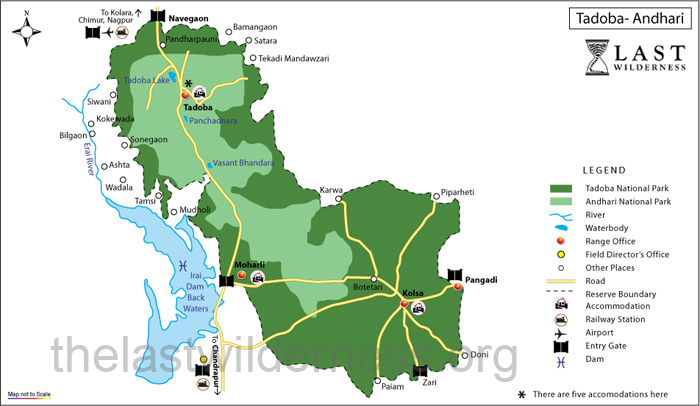
Tadoba map
There are SIX gates or points of entry at Tadoba National Park:
Moharli/Mohurli (approx 180 km from Nagpur): NINE vehicles allowed every morning and evening (total of 18 a day) for a tiger safari from this gate.
Kuswanda Gate (approx 140 km from Nagpur): FOUR vehicles allowed every morning and evening.
Kolara Gate (approx 120 km from Nagpur):NINE vehicles allowed every morning and evening.
Navegaon Gate (approx 140 km from Nagpur): SIX vehicles allowed every morning and evening.
Pangdi Gate (approx 250 km): TWO vehicles allowed every morning and evening.
Zari Gate (approx 190 km): SIX vehicles allowed every morning and evening.
Accommodation facilities are best found near Mohurli and Kolara gates.
MTDC and FDCM guest houses are the best located and cheapest places to stay with all basic amenities. However, food options are very limited. They only have online booking facilities. Do not try to call them.
Royal Tiger Resort is another very affordable place right next to Mohurli gate. It is a favourite haunt for photographers. There are other resorts too to suit your budget needs. Check this site for very comprehensive information on TATR.
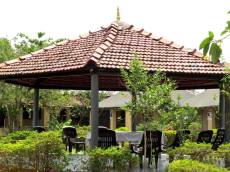
We were very happy with our stay at Serai Tiger Camp. The “tents” were very spacious and comfortable and the food very wholesome. The staff was also very helpful and polite.
At the Kolara gate, the most famous high end resort is Svasara but Chava is much more reasonable and very good, according to my friends who have stayed there. Their food is very good too but 100% vegetarian. The biggest plus of this gate is that it is much much quieter than the very touristy and noisy Mohurli.
We had been warned about the deadly heat in that part of the country but had also been assured that in early April, the heat will be bearable. However, while driving to Mohurli gate in an open Gypsy, we felt we were passing through a furnace. Our hats and sunglasses hardly provided any relief. The jungle did not provide a canopy either and we got roasted almost until sunset. Looking at the headgears of the other tourists, who were all dressed up as the infamous bandits of the Chambal Valley, we all realised that we had made a BIG mistake in our estimation of heat.(So do take a wet towel) But our excitement and very good sightings made us forget the heat for a while.
The first thing that struck me about the park was how beautiful and green it was. I live in Kenya now and just as my safaris there are never only about lions, I did not come to Tadoba just to see tigers. Of course, I was desperately hoping to see one, for the first time ever, but that did not make me oblivious to the birds and other animals of this place. And the amazing diversity of the flora and habitats in this small area.
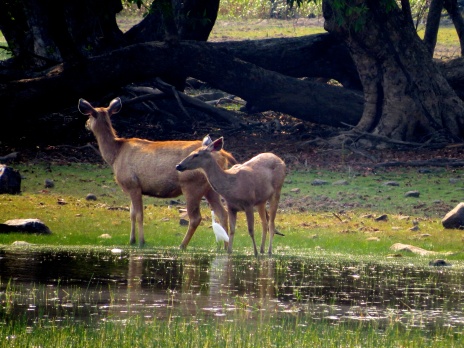
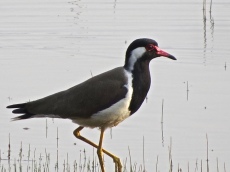
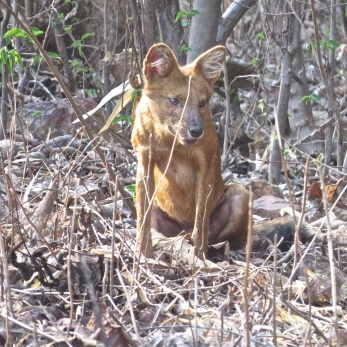
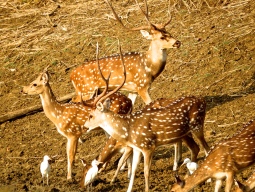
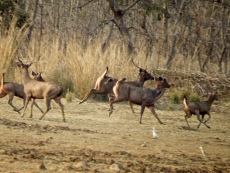
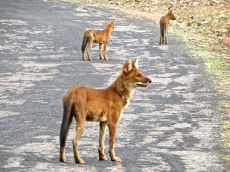
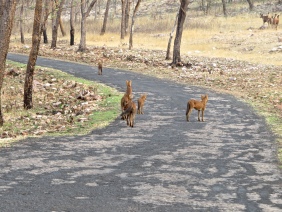
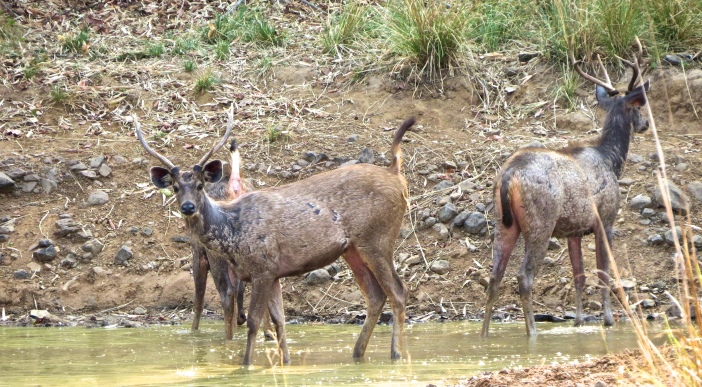
Gaur (Indian bison)Dhole (Indian wild dog)Lovely snoozing place of the dholes to escape the scorching heatOpen billed storkHoney buzzardChital (Spotted deer)Sambars taking refuge in Tadoba Lake
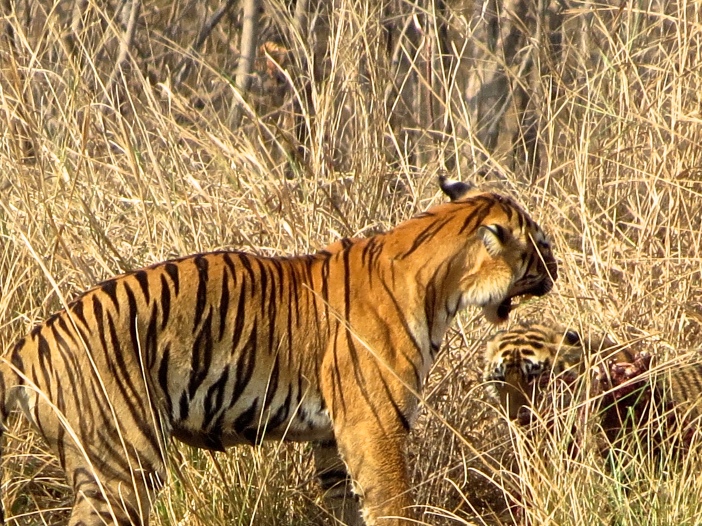
We were lucky to see the famous tigress Maya (P2) with her cubs at Pandharpauni within an hour of our first safari near a watering hole.. The amazing camouflage provided by the dry long grass has to be seen to be believed. How beautifully the stripes merge with the golden colour of the reeds and grass. Keep looking and you suddenly get to spot this magnificent animal.
The Queen of Tadoba – Maya or T2See the camouflage I was talking about: Now you see them, now you don’t
She had 3 boys and a little girl who came out to pose for us in the open. But the mother and her sons continued feasting on the sambar they had killed the previous night. The female cub was so much smaller.
The standard practice for safari cars is to wait infront of the watering hole and you are normally rewarded with a tiger sight. This area is famous for Maya. But to see tiger you might miss other things elsewhere. The flies in front of Pandharpauni is notorious. SO YOU MUST TAKE INSECT REPELLENT.
The little sisterI am a tiger too!But awww, I am still a kid
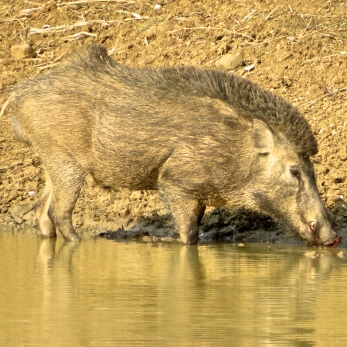
Suddenly , we saw a wild boar come to drink water near them and I was sure that he would be killed but thankfully, the tigers were not interested. There were some thirsty birds around too, all flocking around the waterhole.
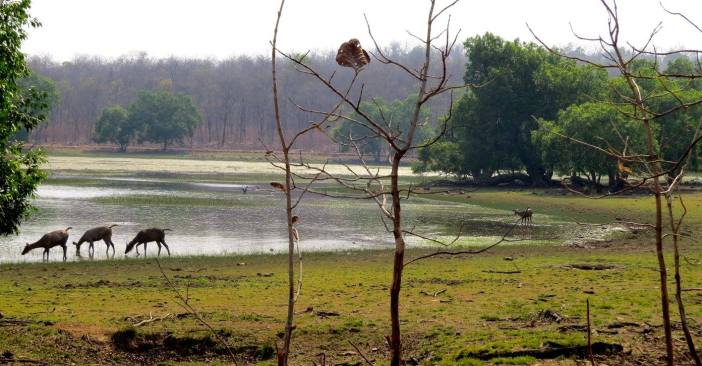
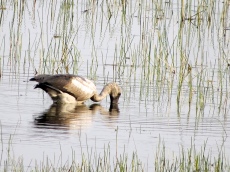
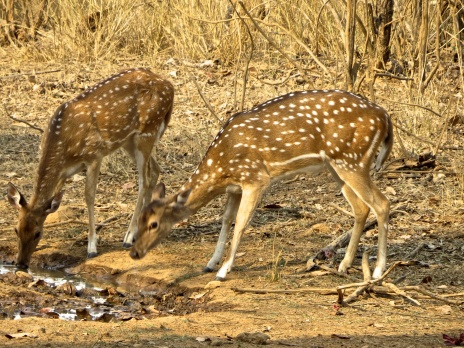
A herd of chitals (spotted deer) also drank water quite cautiously and went on their way. On our way back, we passed by Lake Tadoba and saw quite a few aquatic birds, langurs and sambars.
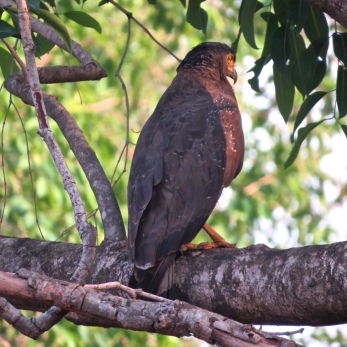
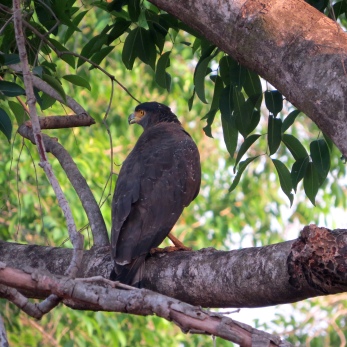
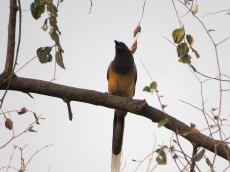
We were also lucky to sight a serpent eagle on our way. As the weather was getting cooler, the dholes were coming out of their slumber and becoming active. We also spotted a Rufus Treepie which is known as the tiger’s dentist.Unlike the fearless ones in Ranthambore, they shied away from human contact.
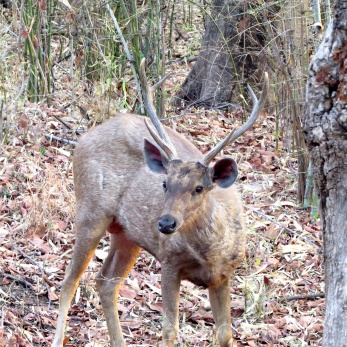
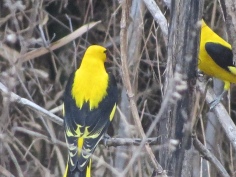
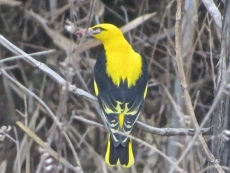
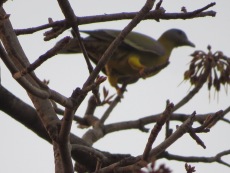
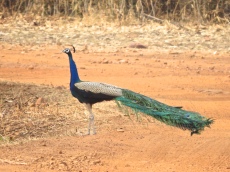
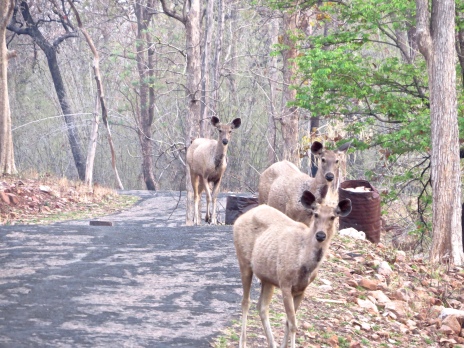
A male sambar was grazing by the roadside. A magpie robin was about to call it a day. We also spotted the very shy barking deer. A pair of golden orioles playing in the bush looked a very pretty sight. The sun was beginning to set and in the dusk light I saw a green pigeon for the first time. I could not make out the colours well but I saw their unique colouring in the morning light the next day. We saw quite a few peafowls scurrying around but they were so frisky that I could just about get a bad shot.
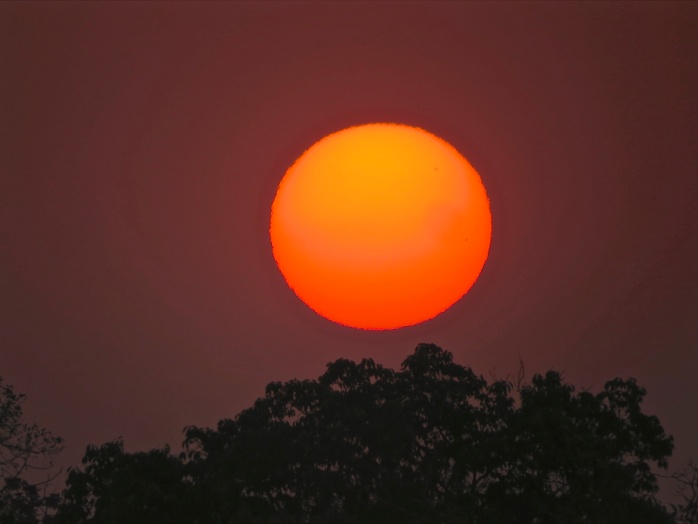
But the day belonged to the magnificent setting sun!
After the safari we returned to our resort at around 6 pm. There is not much you can do after returning to the resort. We chatted with our group members and went to sleep little early since we have leave for early morning safari at 6 am.
03/04/2016 - Day 3
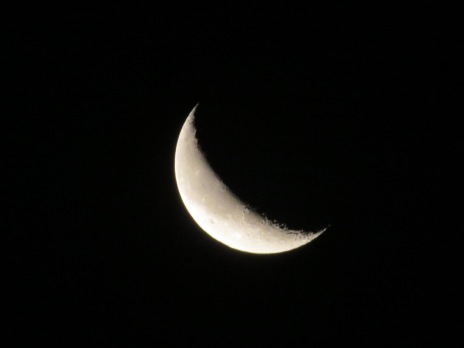
The next day turned out to be a day of of mostly birds and an interesting dhole sighting. But we had to get out when the moon was still in the sky at 4 am (because we could only get an entry through Zhari gate which was quite far away) but were rewarded with a mesmerising egg-yolk sunrise. Actually very few people go there.It is almost 65 Km from Mohurli gate and takes around 1.5 hours to reach there.
We saw many rollers as usual and a pond kingfisher patiently waiting for its breakfast and a langur sitting near it. We also spotted a jungle fowl scurrying away to god knows where. While we waited by a watering hole where leopard sighting was “guaranteed”, I had a chance to observe quite a few interesting birds around me. Especially my favourite ones – the gorgeous green pigeons.
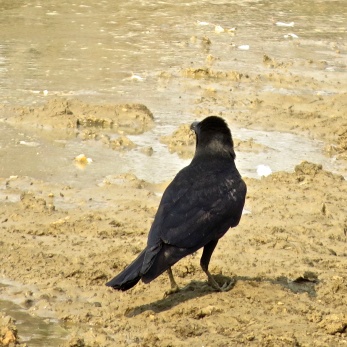
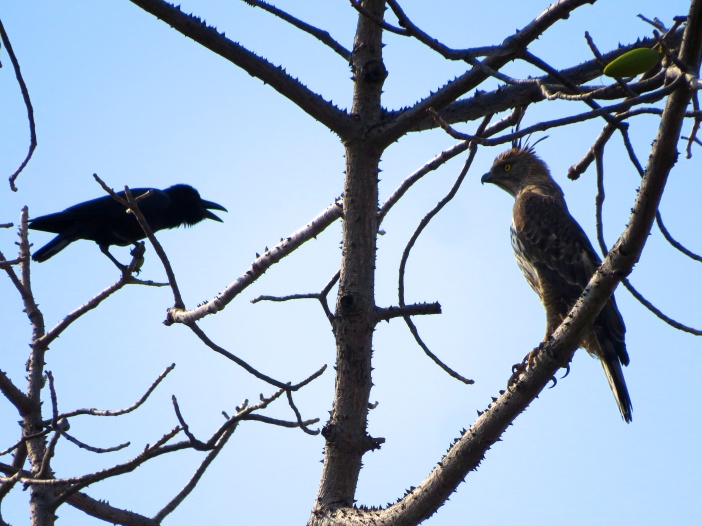
The leopard never came despite an hour-long wait – instead chitals came in great numbers, drank water and left. However, I had a great sighting of a Changeable Hawk Eagle who was probably trying to steal a crow’s eggs/chicks and was challenged bravely the much smaller bird.
The dauntless challengerChangeable Hawk Eagle
Kingfisher and the green pigeons
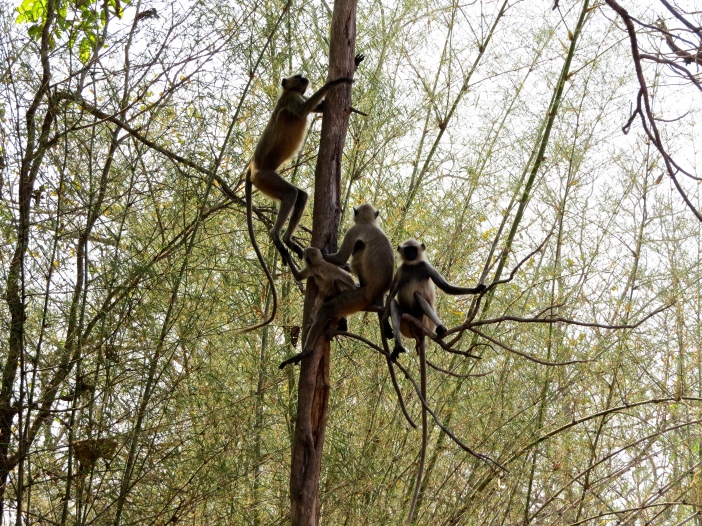
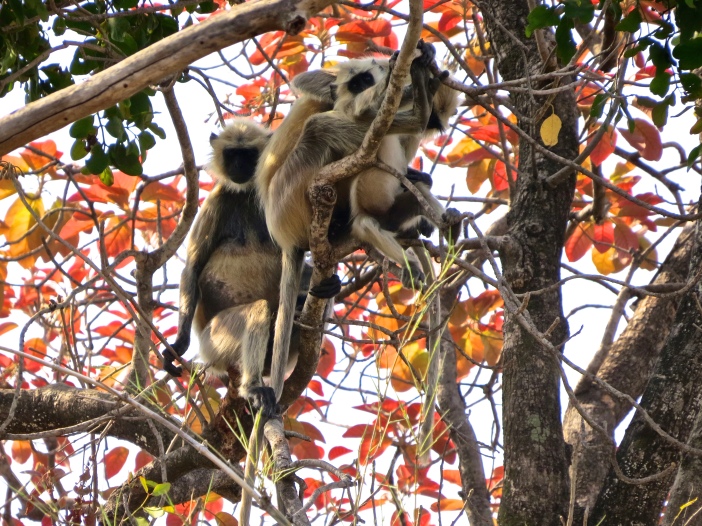
I also got some interesting shots of langurs. And a very unique ant nest made up of leaves. Never seen something like this before.
Monkeying aroundThe beautiful forestDrongo
Ant nest – you can see the big red ants all over
In the afternoon our entry was through Mohurli gate, we had a glimpse of one of Sonam’s cubs at Jamunjhora. Later in the afternoon, Sonam and the other 2 cubs had also emerged, we were told by another guest at our lodge.
Sonam’s cub approaching the watering hole
First full view
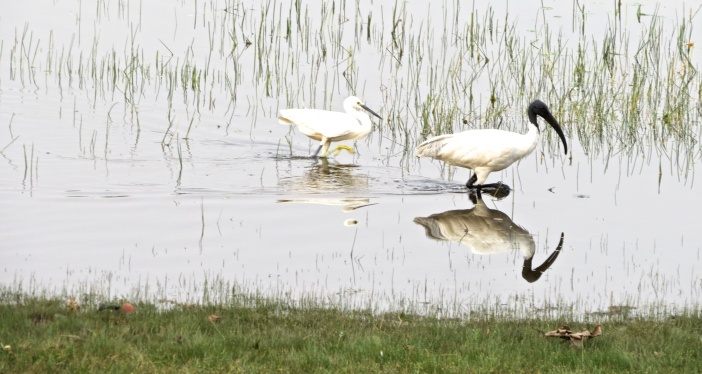
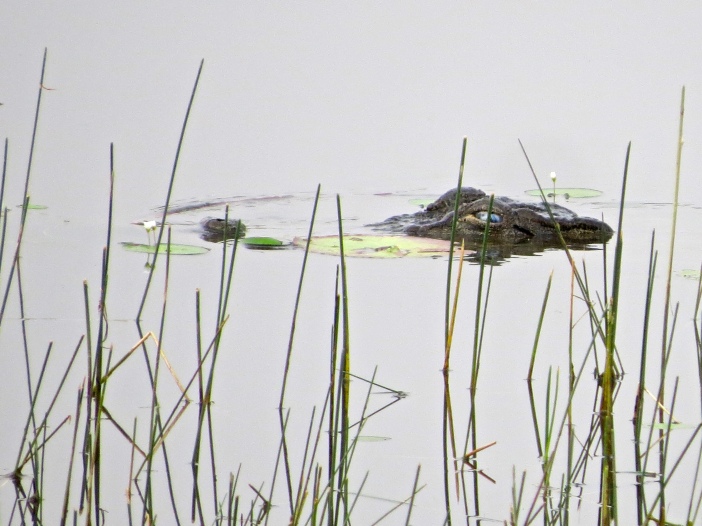
On our way back, we passed by Tadoba Lake which always is a treat for sore eyes.
Black headed Ibis and little egretCrocSambars
Our driver then dashed towards Pandharpauni again to check on Maya. We didn’t have much of a say though. We had a good sighting the previous day and the waiting place is infested with flies who don’t give you a respite. So remember to carry insect repellants if you want to wait here. We did sight Maya in the long grass and she seemed to be initially interested in a kill but then the sambars got a wind of her presence and scampered away, alerting all and sundry. The chitals followed suit quickly.
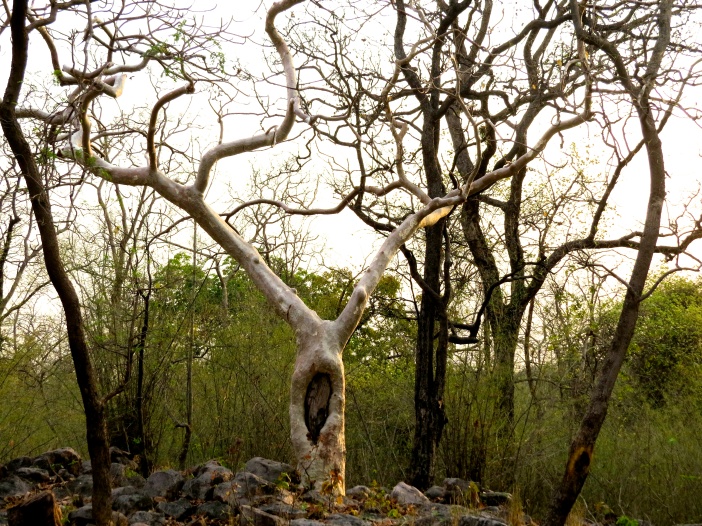
On our way back, we saw the ghost tree (that changes colour every season; white in winter, pink in spring and brown in summer) and some more birds. When it is white, its silvery bark glistens in the dark, especially on a moonlit night. We were there in April and a few of them quite ghostly white, although it was beginning to change colour.
Reminded me of Harry Potter’s Whomping Willow
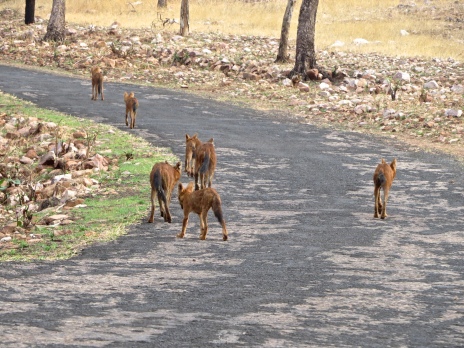
The we saw a pack of dholes on a hunt. They seemed to have some kind of plan as they disappeared up on a hillock after coming close to the group of sambar. We could not wait long as it was getting dark.
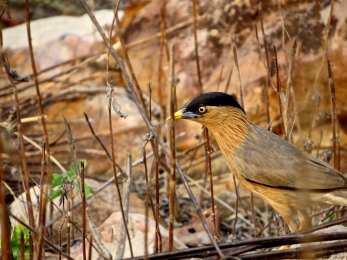
I spotted a ruddy mongoose with some kind of berry in its mouth. Also, a Brahminy starling, treepie, peacock and barking deer.
And then we got back to the lodge for the night. The sunset was nothing spectacular like the other day. We saw a peacock engaged in a mating dance but promptly showed us his back as we came closer. In any case, the object of his attention had moved away.
04/04/2016 - Day 4
We passed by the beautiful Telia lake on our way to Choti Tara territory but she was not there. It was a lovely morning and we got some new bird sightings.
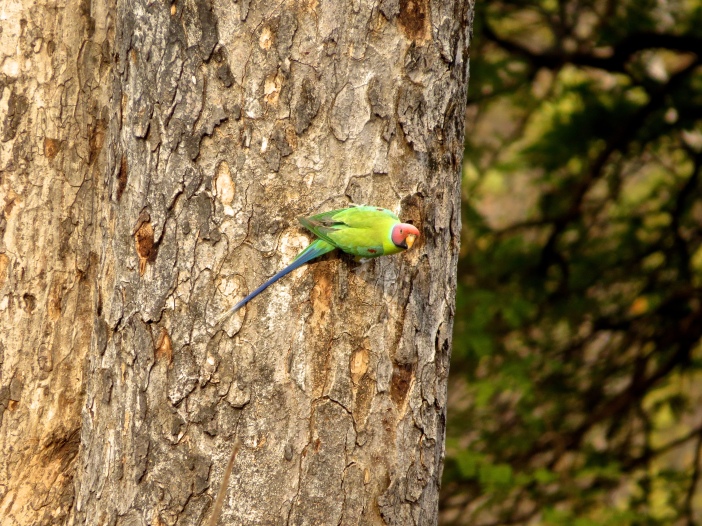
I saw a magnificent plum headed parakeet, a green bee eater and an evil looking crocodile.
Plum headed parakeetGreen bee eaterCrocodile
I missed the chance to click a lovely frame of a golden backed woodpecker but could capture a yellow crowned one. They too have an amazing camouflage and I could not see it first against the bark of the tree.
I finally managed to get a clear shot of the resplendent jungle fowl as well. It was again in a mad rush but thankfully it stopped just long enough for me to photograph it. And there were quite a few treepies which gave us hope of a Sonam spotting.
Jungle Fowl
Show for the femaleRufus Treepie – always around tigers to clean their teeth
We almost failed to notice the bamboo plant next to which our jeep was parked. It was flowering, which is a once-in-40 years phenomenon, after which it dies. It also gave me time to admire the light and shade play on the leaves.
The captivating bamboo flowersIsn’t the canopy awesome?
We waited patiently for Sonam to make another appearance but while she disappointed us, we saw an array of animals coming for a drink of water, one after another, despite the lurking threat. It was so much fun watching this free animal show.
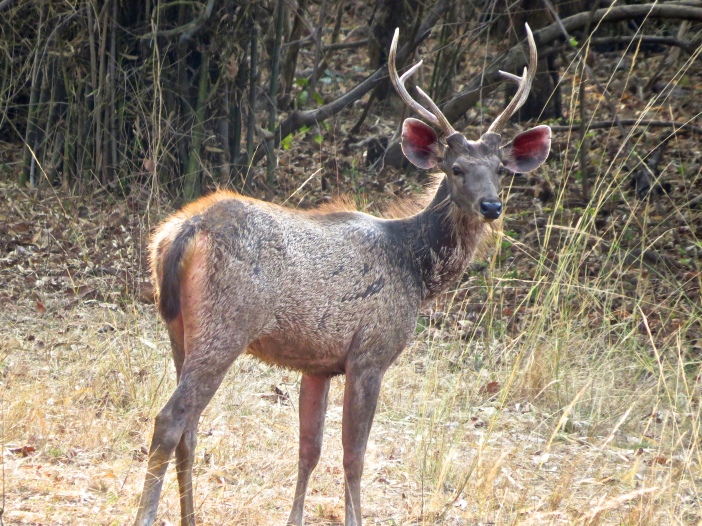
Wary male sambar walking towards the water
First arrivals
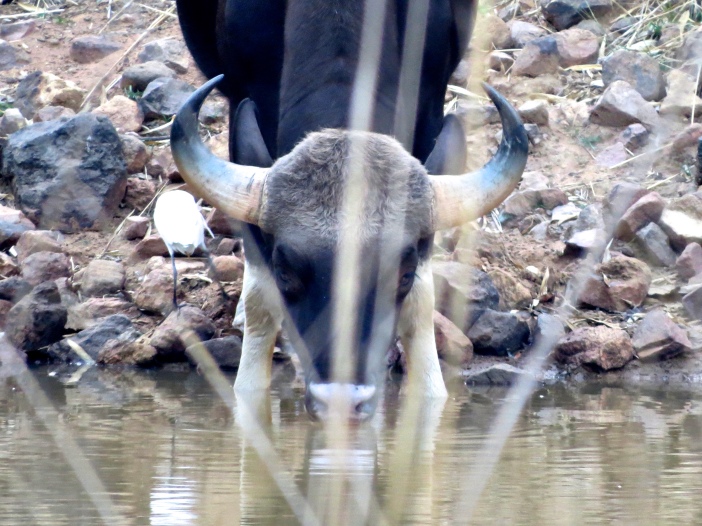
The sambars were there first to give relief to their parched throats but there were on high alert. Next to come was the majestic white-socked gaur.
The don’t-mess-with-me look
A pair of shy charsingha were next in line. Only a video can show the trepidation with which they approached their drinking site.
A pair of charsingha
Oh for a gulp of water
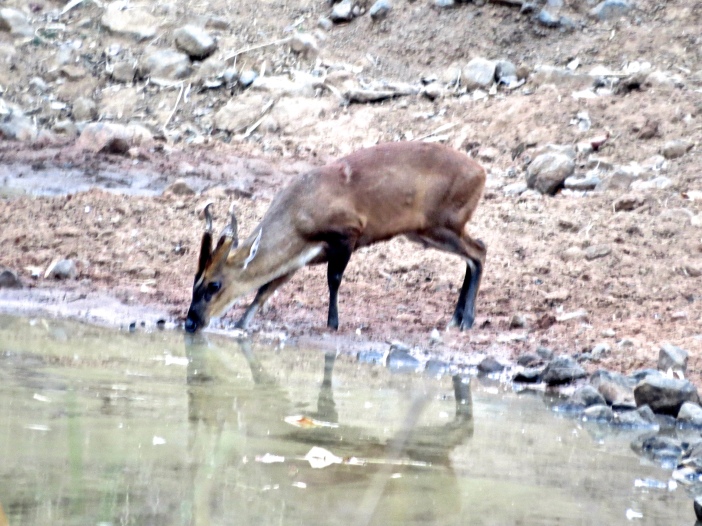
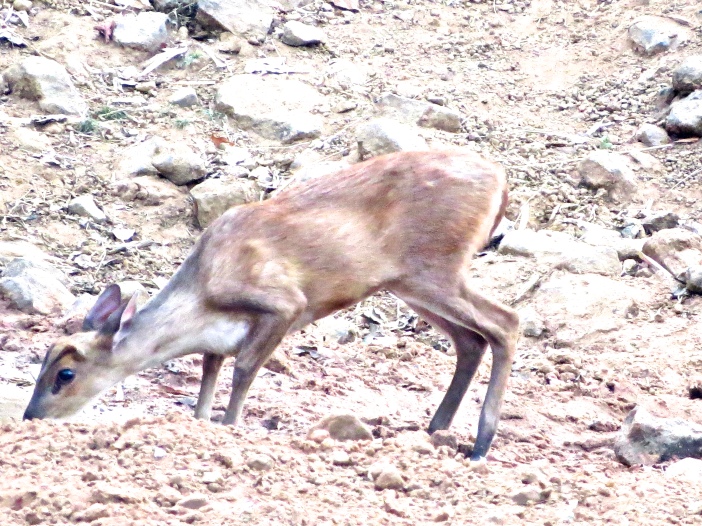
A pair of barking deer joined them soon after.
Barking deer
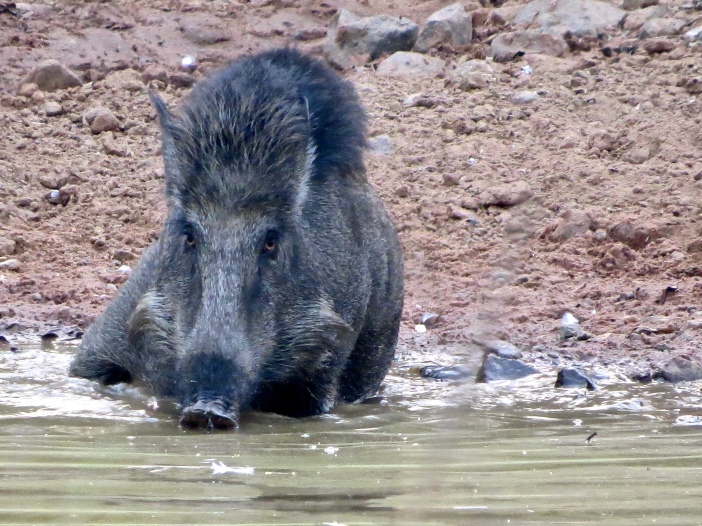
A bunch of langurs were also hydrating their bodies and soon, a wild boar joined them.
Thirsty langursThe boar could not resist taking a roll
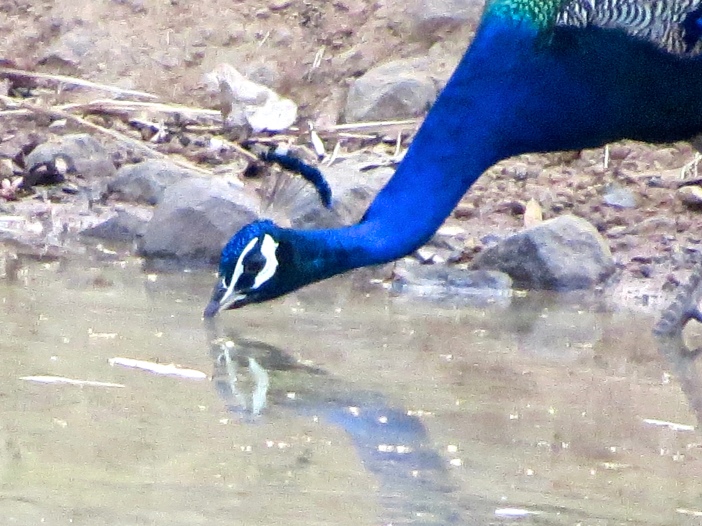
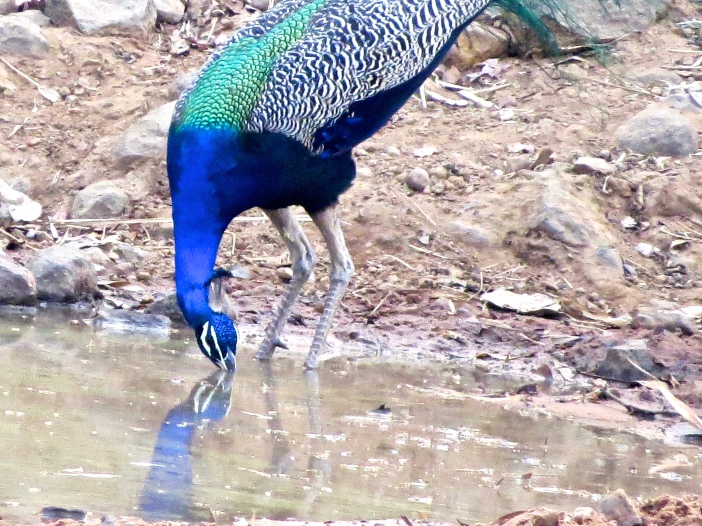
Then came the peacock, very nervy and jumpy. Could not drink peacefully at all.
Our majestic national bird
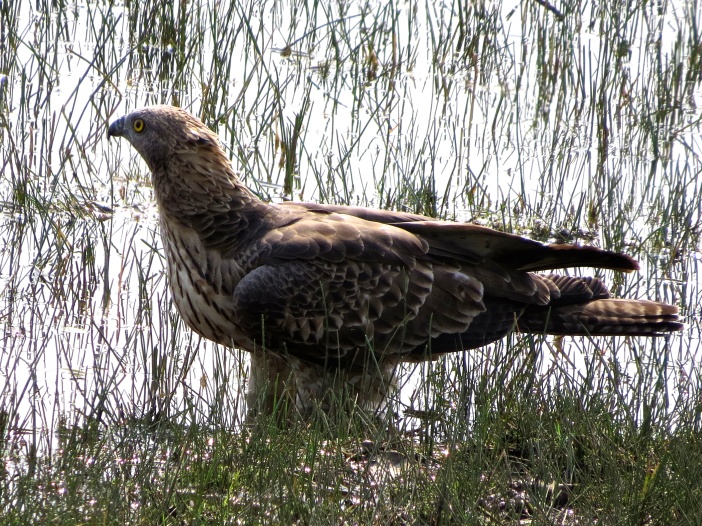
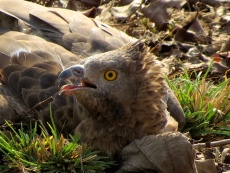
A white eyed buzzard was the last one to come for a drink that evening. The sun was beginning to set and it was time for us to leave.
White eyed buzzardEnd of the day 05/04/2016 - Day 5:It was our last safari in Tadoba and we wanted a real close encounter with the tiger. Today we visited the buffer zone. All our sightings had been across a waterbody. The first 2 hours were quite unproductive except for learning about the crocodile bark tree.Crocodile bark tree
There was a watering hole which was been frequented by the Wagdeo, the oldest and biggest tiger in Tadoba and his cubs. We were told that he had a new young romantic interest called Aishwarya who was the sister of his former mate. But there were conflicting reports about whether the cubs were Aishwarya’s or her sister’s.
After spotting nothing for over an hour, we went to explore the right side of the buffer zone, while my brother and his group who were in another gypsy stayed behind. Barely a minute after we left, their wish was fulfilled as Wagdeo along with his cubs and Aishwarya made an appearance at that concrete watering hole. After frolicking for a while, they disappeared as the tourists were making too much noise. Here is what my brother saw. He did add that the experience felt very artificial – almost like a zoo.
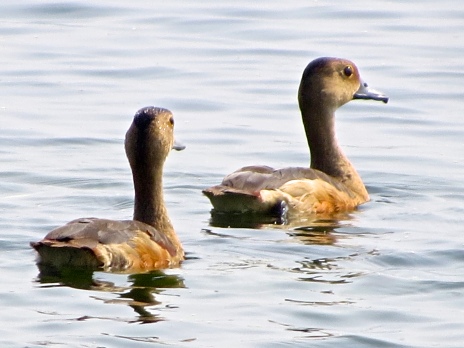
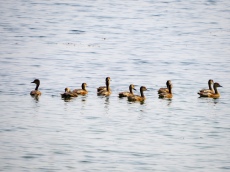
Later we got to know that as we were leaving that side of the buffer zone, some drivers tried to call us as the tigers were spotted. Meanwhile, we went exploring on the other side where there was the vast Irai Lake. We found a purple swamp hen, a lesser adjutant stork and some whistling ducks. I also saw a beautiful flower whose name I still do not know.
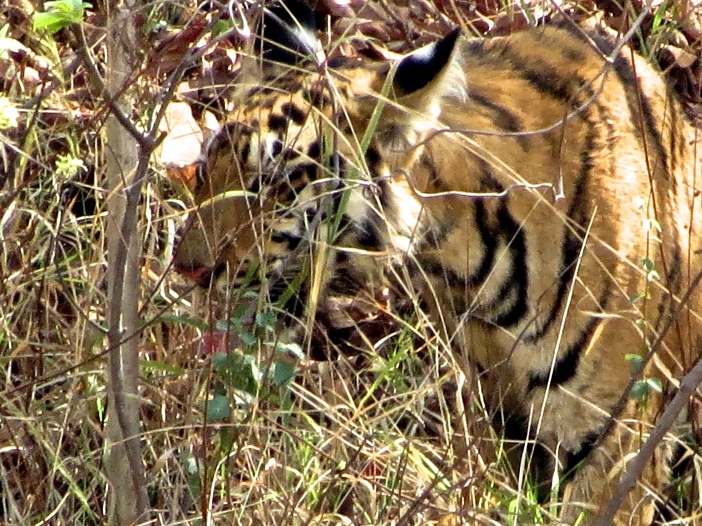
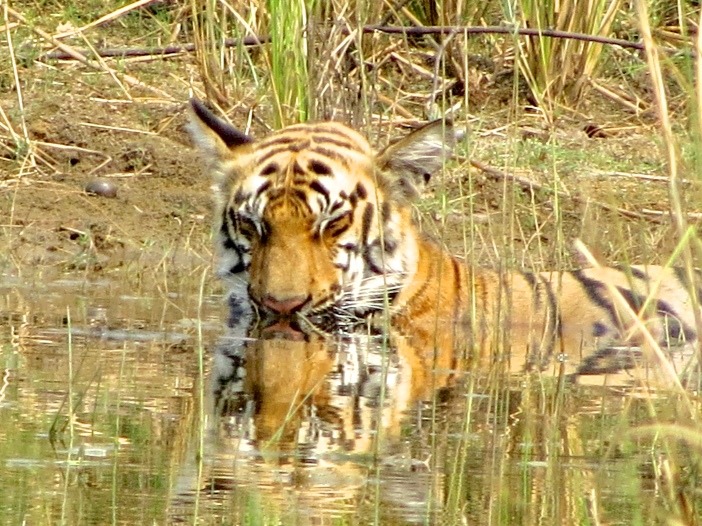
We saw some fresh pug marks but failed to see any tiger. Just as we thought our luck had run out, we found a jeep full of photographers beckoning us wildly. Across an expanse of water, was one of Sharmilee’s cubs peacefully dozing in the water. We missed our much desired “close” encounter by a few minutes as the tiger was just in front before she wanted privacy from the photographers. But we could clearly see the cub with our naked eyes.
Our first glimpseDozingEyes openWho disturbs my slumber?You guys again!
We went inside the forest to try and find Sharmilee and her second cub but could not. The bamboo grove was fabulous though. But when we came out, we found another cub in the water! The mother must have been somewhere close.
Appearance of the second cub
On our way back, the jeep stalled. Thankfully, the driver knew what to do and we came back safely without becoming fodder for the tiger.
Tadoba Andhari Tiger Reserve (TATR) is Maharashtra’s oldest and largest National Park. The current TATR (625.4 sq km) was established after Tadoba National Park merged with Andhari Wildlife Sanctuary
TATR is divided into 3 forest ranges – Tadoba, Kolsa, and Mohurli (sandwiched between the first two)
The rain-fed Tadoba and Kolsa lakes together with the Tadoba river sustain the park’s diverse eco-system.
It is open from 15th October to 30th June
Closed every Tuesday (and on Holi) but the buffer zone is open
Book your safari onlinebefore you look around for any accommodation or transport
It helps if you can arrange for a good guide and driver but they are readily available at the gate on a rotational basis but a good one may not be guaranteed
IMPORTANT INFORMATION FOR FIRST-TIMERS
Safaris can be booked by you online at this site. Bookings are open 120 days in advance but they go away very quickly. However, some resorts do it for you at a nominal charge. A safari costs about Rs 3500 per jeep. Not person. Keep some cash with you.
Forest entry fee – Rs 1000
Gypsy charges – Rs 2000 (IN CASH) unless the resort arranges one for you before
Every camera over 250mm lens – Rs 200 (in CASH)
Compulsory Guide – Rs 300 (in CASH)
The group leader’s name along with his/her ID details are required during the booking. He/she MUST be present while entering the park; else the permit will be canceled. It is better to enter more names, as cancellation is not an issue (a jeep can carry a maximum of 6 people plus driver & guide). Add-ons are allowed but I am not too clear about how it is done — all I can say is that it can be done at the gate for an additional fee. According to rules, the names cannot be altered after the safari booking but some do it illegally. Usually, only the group leader’s ID is checked but a random check may happen any time. So it is better to keep your IDs with you. Remember to carry a printout of the online receipt with youat all times. Please keep a photocopy of your ID. A much cheaper canter bus safari has now been introduced (@ Rs 400 per head) but you must reach the gate very early and wait for the bus to be filled up to a required minimum number (possibly 8) of tourists.
The village of Metekhali (on the way to Nazat or Nyajot), sandesakhali, with its natural beauty and indigenous culture transports you to a different world . It is a tribal village where you can go and come back within a day. We (Phejin, Peter,Sanjit-da and son, Koyeli and her family,Sujoy & me - 9 in total) left for Metekhali in the Tata Winger.
Directions to go there:
By train
Take Hasnabad Local from Sealdah station - get off at bhybla.
Train timing are 5.18 am, 6.12 am and 7.47 am. It take less than 2 hours to reach Bhyabla. Train fare is Rs 20. From the Bhyabla rail gate take a bus / auto etc which is going towards nazat and you have to get down at metekhali
By Bus
Buses from Science city takes you to Malancha Bazar and then you take an auto/Trekker to reach Metekhali on the way to Nazat. Malancha Bazar comes after Ghatakpur.
By Car
We went by car. From Ruby Hospital More, we went straight (without taking left turn towards Science city) and took the route of Basanti Highway. From Ruby Hospital, in 10 minutes, we were transported to a different world.
We had our snacks/breakfast at Malancha Bazar. From Malancha Bazar we took a right turn after crossing the Malancha bridge, to go towards Nazat. There is no need to go Bhyabla if you are going by car. On the way to Nazat we took a small road (towards left) to reach Metekhali. This is part of Sandeshkhali near Sundarban. The moment, after entering the village you will be stuck with the natural beauty and Indigenous culture - you can get acquainted with their day to day life . When you come here you will suddenly feel you are in a tribal village in Jharkhand.
With Trees all round and pure air – it is a good place to go for people like us who are living in a city.
When the dam was made by the Britishers on Ichamati river - the English brought some tribal people – Munda,Oraon from Jharkhand. Ultimately when the damn was done - they settled there. Their main source of income is fishing.You cannot go there during the rainy season because area becomes flooded.
We took our car till the ferry ghat. At the ferry ghat we crossed the river (ferry charges Rs 1 per head ) and had some tea and snacks after crossing the river. Then we started walking . After spending some time in the village ( we went inside the homes of the villagers) it was time to come back to the ferry ghat and cross the river by taking the boat again. We took the car , stationed at the ferry ghat, to go back to the main road.
Special breed meant for cock fight - apparently costs Rs 3000-4000 approx
The village is also home to various festivals like Tushu. We learnt that every Sunday, cock fight takes place at Nazat.
Honestly there is not "much to see" ! You can persuade the villagers to cook lunch for you. In fact I did ask them to make it for us. There is a chicken farm near the ferry ghat. It is possible to buy it from the farm and tell them to cook for you - while you roam around the village.
We had our lunch at Murarisah Choumatha (at the T junction - where one road goes towards Taki. Initially we had planned to go to Taki Guest house for lunch - Ph no. 0321 7233328. They serve lunch @ Rs 80. We even talked to them over phone. But for dearth of time we changed our plan) and left for Dhanyakuria. There is no eatery in Metekhali. The food was good and really cheap. The chicken at Rs 40 with 3 pieces was really a good deal at Adarsha Hindu Hotel.
We took Basirhat Nazat road (instead of Taki road to reach Taki) to reach Basirhat, in North 24 Parganas district, near Bangladesh border. From Basirhat we took Taki Road (NH 2 - it forms a loop at Taki - see the map) to reach Dhanyakuri , which is nearby.
"Dhanyakuria is also about 30 km from Dum Dum. It takes two hours to reach Basirhat from Dum Dum and another 30 minutes to reach the village which is a little-known treasure house."
"Not featured in the list of tourist destinations of West Bengal, the settlement showcases plenty of lavish mansions of fusion architecture, belonging to zamindars and merchants of yesteryear."
"Few families of zamindars belonging to different castes once held sway over the village of Dhanyakuria. It may not be their fiefdom any longer but the palaces they constructed, which were show-pieces of fusion architecture, have survived and are still well looked after." "Once a part of Sunderbans, Dhanyakuria was converted into a proper settlement for living in 1742 when one Jagannath Das settled here with his family. Likewise families of many traders like Gaine, Sawoo and Ballavs came and settled in the village and became affluent. This is when these families built up several mansions. The area was famous for Rice and Sugarcane. Vaishnav culture was predominant in the area.
Out of the many mansions in the vicinity, the mansions of Gaine, Ballav and Sawoo are still well maintained. The first structure that attracts a visitor is European Medieval style gate with two towers on the main road. The gate is the entrance to a high walled enclosure. A signboard in Bengali states it to be State run orphanage.A smaller signboard says “No Entry without Permission”.
There is a caretaker, who after lot of persuasion allowed us two steps inside the enclosure and the first thing to attract the visitors is a mansion which resembles like an English Castle! With water body in its front and green vegetation around, a first time visitor on a cold winter morning can be virtually transferred to English countryside. But the “Castle” was never the property of any English nobleman. This was the Summer House alias Baganbari alias Gayen Garden of the local Gayen or Gaine family, who were one of the early descendants of the area. This vintage structure was built by Mahendranath Gaine, a wealthy landlord and businessman during the beginning of 20th century. " Incidentally Somen Gaine our friend from my neighbourhood belong to this family. He helped me by guiding me to reach the destination.
"Since this a girl’s orphanage the caretaker will not permit an unsolicited visitor further beyond the water body.
The entry to the settlement is through a mid-sized lane from the Taki Road just beside the Gaine Baganbari. Going through this lane named Dhanyakuria Benepara road, one can see the pink building of Dhanyakuria High School on the left. Around 300 metres from the main road comes the first grand mansion."
I. "The first grand mansion which greets a visitor to Dhanyakuria is that of the residence of Gaine family. Adorned with light pink colour, the L shaped Gaine Mansion is an excellent example of fusion architecture. The two storied mansion is studded with several Ionian pillars besides the long open corridors in both floors."
"The Founder of Gaine Family was Gopinath Gaine. The Gaine family had a joint venture business with the Ballavs and the Sawoos. They dealt with trading of Jaggery, Jute and other Commodities. From the profit of that business, they invested in real estate and set up colleges and donated to charity.
Mahendranath Gaine, the worthy son of Gopichand Gaine, built this mansion about 175 years ago. He had direct business dealings with the British. Benefiting from business dealings in Jute, he started a Rice Mill at Dhanyakuria. He started Durga Puja in this house.
The descendants of Gaines are still well off. Except Kanchan Gaine who is in his 70s, the rest of the family members have settled down in Kolkata and other cities. There is a family get together at the Gaine residence during Durga Puja which is held every year with pomp and show. The idol is placed on the Thakurdalan inside the mansion. Durga Puja is celebrated maintaining old rituals. On the last day of the festival, involvement of people from Kahar community is still prevalent. These people carry the idol on their shoulders for immersion to the water body.
Gaine Mansion has been a film makers favourite since long. From yesteryear Saheb Bibi Golam to present day Satwenashi by Rituparno Ghosh, many a films have been shot in these premises.
Just besides the Gaine Mansion, there is the temple of the presiding deity of the family – Shyamsundar Jiu. This one storied building is also painted in pink. The Temple is said to be established during 1821.
II. Coming out of the Gaine Mansion, a brief walk on the opposite lane takes to the Sawoo Mansion on the right. The white coloured building has embedded Corinthian Pillars on its walls along with stucco decoration over window arches on its exterior.Some of the windows have shades on the arches, while some arches are subdivided into two smaller arches with stained glass design on them.
In 1885, descendant of Sawoo family – Upendranath Sawoo along with Mahendranath Gaine founded the first English School of Dhanyakuria. At present no one of the family resides in the house." When we reached there it seemed to me no one stays there.
III. "Walking straight down the road leads to another lane on the right in the corner. Strolling down this path besides a pond leads to another magnificent mansion on the left – the two storied residence of the Ballav family.
Ballav Mansion alias Ballav Bati was built by Shyamacharan Ballav almost at the same time when Gaine’s Mansion was constructed. Shyamacharan Ballav became rich by trading in Jute. The present generation of Ballav has their descendents spread over various parts of West Bengal. Near Shyambazar area of Kolkata, there is a huge mansion of the Ballav Family.
There is a beautiful and well maintained garden in the Ballav Mansion premises. The most interesting part of the Ballav Mansion is the presence of some idols on the terrace of the house. Locally this Mansion is known as “Putul Bari” alias “House of the Dolls”.
IV. At the end of the premises of Ballav house, there is a three storied tower which is design wise similar to the Nazar Minar of the Gaine family. Unlike Nazar Minar, this structure is outside the premises of Ballav House. Also it is painted in yellow and has two human figurines on the top. It seems there were more figurines, but at present only two remains."
V. "Walking down further this road one encounters a huge Nine Pinnacle two storied Rasmancha on the right .The strucuture looks like a typical navaratna temple so common in Bengal. Except that the nine-tower structure supported on Corinthian pillars bunched together is perhaps the only one of its kind. Corinthian pillars are a rarity in navaratna temples. The structure has 5 arches on each side of the ground floor supported by pillars. The first floor has 3 arches. Each floor has 4 towers and one on the top. It has cast iron railings on top with floral designs."
VI "At a stone throw distance from the Rasmancha is the gate of Sawoo Baganbari alias Sawoo Summer palace. A huge gate adorned with Corinthian Pillars leads to the garden. The premises have an extensive area much like the Gaine Baganbari. The Sawoo Baganbari mansion is impressive too, but nowhere near in glamour and grandeur as compared to the Gaine Castle.
A trip to Dhanyakuria can be a refreshing weekend day tour especially during Durga Puja."
If you want to go to just Dhanyakuria by train, take Basirhat local from Sealdah and get down at Kankra Mirzanagar Station. The journey is around 1:30 hours. From the station take a local transport which will take you to Dhanykuria via Kankra Kachua Road. There are many transportation options available.On reaching Dhanyakuria you may hire a cycle rickshaw for sightseeing.
Or get down at Basirhat and come here by hired autorickshaw.
Now it is time to come back and we returned home in 2.5 hours time to South kolkata.
Source:
The part of article in italics is an exact copy of the articles written in these two blogs.






















































 A pair of shy charsingha were next in line. Only a video can show the trepidation with which they approached their drinking site.




 A white eyed buzzard was the last one to come for a drink that evening. The sun was beginning to set and it was time for us to leave.








 On our way back, the jeep stalled. Thankfully, the driver knew what to do and we came back safely without becoming fodder for the tiger.


