Showing posts with label Street Foods of Calcutta. Show all posts

Friday, February 17, 2023

Walking tour of Famous Restaurants/street food of North Kolkata

Not Delhi, not Mumbai, but the metropolitan city of foodies- Kolkata, the capital of West Bengal, India has made its way to the list of eleven best food destinations in the world for 2023 according to a website called eaters.

https://www.livemint.com/news/india/kolkata-land-of-aloo-in-biriyani-is-only-indian-city-on-eater-s-list-of-11-best-food-destination-in-the-world-11673625981836.html

For quite some time I planned to document all the famous street foods/Restaurants in and around Bidhan Sarani, College Street. Finally on 04.02.2023 I did it with 2 of my friends.

আমরা যারা দক্ষিণ কলকাতায় থাকি তাদের সব গুলিয়ে যায় ! তাই সবার সুবিধার জন্য লিখে রাখলাম।

Pranajit Bose has been a great help in planning this tour.


Some of these places I tried before, not this time

1. Basanta Cabin
- 4/10 (not many people visit these days) - famous for Kabiraji

(
https://www.getbengal.com/details/almost-century-old-basanta-cabin-of-college-street-holds-on-to-its-charm)

2. Putiram
- 7/10 - - famous for Kachori . Shri Hari opposite Bijoli, near Hazra More is better

(
https://www.getbengal.com/details/rajbhog-and-kochuri-at-150-year-old-putiram )


3. Kalika
- famous Chop - did not try

(
https://www.getbengal.com/details/iconic-kalikar-chop-er-dokan-that-still-sells-prawn-chop-at-just-rs-10)

4. Paramount Sherbats & Syrup
- 7/10 -  famous for Daab Sharbat etc. Quite expensive and bit hyped  - Acharya Prafulla Ray used to come here

(
https://moha-mushkil.com/sherbet-story-heritage-kolkata-paramount/)


5. Dilkhusha Cabin
- 4/10 -  famous for Kabiraji. Kaji Nazrul used to come  (https://www.getbengal.com/details/dilkhusha-cabin-got-prestigious-heritage-eatery-tag-yesterday-110-year-old)


6. Indian Coffee House
- 6/10 - famous for Ambience  (food is nothing special and quite expensive) (https://en.wikipedia.org/wiki/Indian_Coffee_House)


7. Kapila Ashram
- 8/10  famous for Sherbat (Abar Khabo and Malai Sherbat is very good value for money at Rs 30) 

(
https://yummraj.com/2014/10/20/kapila-ashram-2042-bidhan-sarani-machuabazar-kolkata/)


8. Adi Kapila Ashram
- 7/10 -  famous for Sherbat
(this is the one run apparently by their erstwhile employees, not the original one ) 


9. Niranjan Agar
- 6/10 - famous for Dimer (Egg) Devil

 (
https://www.telegraphindia.com/my-kolkata/food/niranjan-agar-is-the-100-year-old-kolkata-cabin-famous-for-its-dimer-devil-or-devilled-duck-eggs-fish-fry-fowl-curry-and-more/cid/1869311)

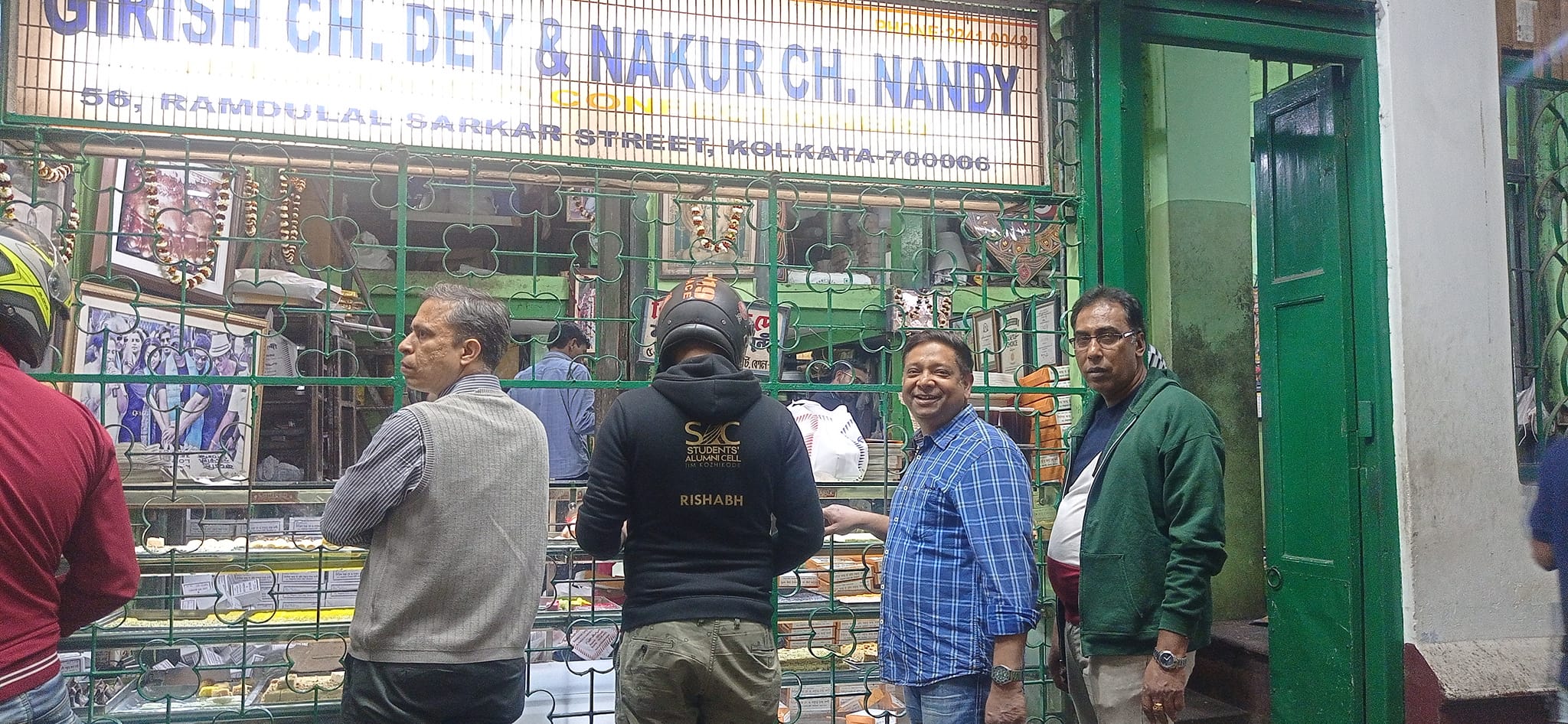
10. Girish Chandra Dey and Nakur Chandra Nandy
- 9/10 - famous for Sandesh

(
https://deepsmonologue.blogspot.com/2016/06/GirishChandraDeyNakurChandraNandy.html?m=1)

11. Nalin Chandra Das
- 8/10 - famous for Sandesh

12. Lakshminaryan Shaw & Sons
- 7/10 - famous for Chop - Netaji used to come here.

You can get better Alur Chop at the one near Lake Mall,  beside Lake Market (towards Rashbehari More)

(
https://moha-mushkil.com/lakshmi-narayan-shaw-best-telebhaja/)

13. Mitra Cafe
- famous for Chop (Fritters),  Kabiraji and Cutlet - did not try. 

There is one near City College, Golpark too.
(
https://goodfoodbro.com/mitra-cafe/)

14. Allens Kitchen
- 7/10 -  famous for Prawn Cutlet - quite expensive and bit hyped 

There is one near Hazra More too.

 
https://sumitsurai.com/2011/07/allen-kitchen-restaurant-great-food-history-and-the-special-prawn-cutlet/ 

Tour map 
https://goo.gl/maps/AZPci1H9ambhXA8u5

Monday, November 9, 2015

In search of Sutli Kabab and Kabab Gully in Kolkata


We were planning to have Sutli or Suta Kabab for quite some time. Finally we decided to go to Phears Lane on 8th November 2015. As usual we (Abhik, Koyeli, Oli and Rumki) were late. We reached there by car at around 9.20 pm. 

When we reached Adam’s Kabab (run by Mohammed Salahuddin) has just closed.  They said there are some other places, where you can also get Sutli Kabab and Boti Kabab. We read that it opens only during the evening hours and is located next to the Liyaqat Sweet Shop. It is 2.5 / 3 minutes walk from main road.


In fact the best way to go there is by subway /metro and get down at Central Metro station. But do not get down at BB Gangluly street (towards Lal Bazar) exit of Metro, rather take the India Exchange Place Road/Medical college exit of Central Metro. Now start walking towards Tea Board/Brabourne Road. The first road on the right is Sagar Dutta Land and then after two three roads on the right comes Phears Lane (basically 300 metres from Metro station) - very narrow road - just one car can pass somehow.

We started walking towards Zakaria Street. First we reached Maulana Saukat Ali Street. There is a small road which connects Phears lane to Bolai Datta Lane (Colootala). That lane is apparently called Kababwala gully, we were told (which is basically an extension of Phears lane after crossing Maulana Saukat Ali Lane). 


We saw a shop selling Sutli Kabab. "Initial look gives the impression of an shikh Kabab , with meat being grilled in fat skewers over flaming red charcoals , but  a closer inspection reveals that the meat being barbecued are tied to the fat skewers using a fine cotton thread !" For the uninitiated, Sutli Kebabs, kebabs so soft or delicate, they have to be held together with a twine of thread. You actually have to hold the thread tied over the kebab from one end, and it spreads on your plate, when unfolded. "Unlike the shikh Kabab, which stays on the skewer, the Sutli or suta Kabab disintegrates unless tied together with a thread". Dhaga Kabab or Sutli Kabab is a several centuries old Mughal dish that is now seldom made. Small pieces of beef, but not minced, marinated with herbs and spices are put around the skewers. The secret to this is unripe papaya, an excellent meat tenderizer, mixed in with the mince along with spices and left to marinate. Then the cotton thread is soaked in water and is rolled over the meat. 


According to a blogger (reference given) "The only other place I’ve had Sutli Kababs is in Old Delhi. There, in the Matia Mahal area, past the overrated Karim’s, is the oddly named Kale Baba ke Kebabs. As in most Mughlai food though, the colonial melting deg of Kolkata steals a march over once-upon-a-time-Mughal Delhi."

We ordered 4 for skewers for us - they rolled it in romali roti. It is an unnamed shop. It is really good and one of the best Kabab I had for a long time. It’s really a melt in the mouth experience!!! Kabab is soft, quite juicy, not as soft as galawati but very spicy. The Sutli or Suta Kabab costs Rs 20 per plate and the romali roti costs Rs 3. So the best part is the price!!


Then we started walking towards Zakaria Street. On reaching Colootala Street we saw another restaurant selling Sutli Kabab. They have been featured in Wheels Magazine. They also sell Khiri Kebab (made with the cow’s udder), Malai Kebab (Rs  10). We also had Boti Kabab and Malai Kabab apart from Sutli Kabab. I somehow liked the first shop better.


Route for Kababwala Gully

Other shops in and around area : courtsey Wheels magazine


According to a blogger ( reference given ) "This is the city’s Kabab district. Colootala and Phears Lane are replete with hole-in-the-wall eateries selling every variation of skewered meat. During the month of Ramadan, the entire Zakaria Street turns into a food bazaar. Small stalls selling Bakarkhani & Sheermal Breads, Murgh Changezi, Mahi Akbari, Sewaiyan, Rogni Roti, Shahi Tukras, Haleem, Biriyani and countless other delicacies jostle with stalls of colourful bangles and clothes. From November to February, you can find delicious Nihari early in the morning. "

We were told if we come at 7 am in the morning then we can have Brain or Magz curry. If you walk little forward you will reach Zakaria street. You can see Nakhoda mosque and just in front of Nakhoda mosque you will find Aminia. 
There is labyrinth of shops selling Kababs - mostly beef. So it is a beef eater's paradise.


Reference:

1. https://rangandatta.wordpress.com 
2. http://yummraj.com
3.  http://www.delhifoodwalks.com 
4.http://www.polkacafe.com


Tuesday, March 3, 2015

Food Myths debunked


Finally: the ultimate guide on what to eat


This was the fortnight when everything we thought we knew about eating and drinking healthily was turned on its head.
First, a damning new study in the British Medical Journal showed that — after all we have been told to the contrary — saturated fat is good for you. Far from being the great risk to our health and hearts, it turns out that most people who eat butter, milk, cream and full- fat yoghurts generally have better heart health, less risk of Type 2 diabetes, and are even slimmer than those who eat fat- free... Now experts are saying instead that carbohydrates are the real killer… So what can we safely eat these days? And what had we better avoid? Here, the experts give their " definitive" verdict...

Butter

What the line has been: Avoid butter at all costs and replace with low- fat polyunsaturated spreads.

What we now know: Butter can be good for you in small amounts. " We used to think that if you ate saturated fat, it raised your cholesterol levels," says Dr Michael Mosley, the science journalist.

" It turns out that dairy fats don't work like that in your bloodstream."
Recommended amount: A moderate amount, which may even do you good.

Eggs

What the line has been: Eggs are full of cholesterol.
What we now know: Eggs are good for you and have no link to health problems.

" Dietary cholesterol does not increase cholesterol levels in the blood," says Mel Wakeman, a senior lecturer in nutrition at Birmingham City University in the UK. " Eggs are full of nutrients and vitamins... They contain protein, so will also keep you fuller for longer."
Recommended amount: You can eat eggs three or four times a week.

Milk 

What the line has been: Better to drink semi- skimmed or skimmed.
What we now know: Full- fat milk contains a lot of healthy fats and is just as good for you — if not better than reduced- fat versions. " Just because a food is fatty doesn't mean it's bad for you, as there are different types of fat," says Wakeman.

Recommended amount: Up to half a pint of full- fat milk a day.

Olive oil 

What the line has been: Olive oil is key to better health.
What we now know: Olive oil is fine on salads but is carcinogenic when heated and should not be used for frying. " For frying, I recommend rapeseed oil, which has similar nutritional benefits, but has a high smoke point," says Dr Glenys Jones, a nutritionist.

Recommended amount: A tablespoon a day.

Carbohydrates 


What the line has been: Carbohydrates should make up 50 per cent of your food intake.
What the line is now: Brown carbohydrates are good, but white are deadly.
" I'm a big supporter of carbohydrates," says Wakeman, " but they must be wholegrain.
White spaghetti, bread and rice are not our friends…"

Recommended amount: Wholegrain carbohydrates should make up 50 per cent of your food.

Wine 

What the line has been: A small amount of alcohol, particularly red wine, is good for the heart.
What we now know: The benefits of drinking have been over- stated. " It's certainly good for post- menopausal women because red wine makes the blood less sticky and so lowers the risk of heart disease," says Wakeman. " In younger women, however, the research shows that there is an indisputable connection between levels of alcohol intake and breast cancer."

Recommended amount: A small glass of red a day is probably fine, with a couple of days off a week.

Yogurt 

What the line has been: Stick to the low- fat variety.
What the line is now: Full- fat may be better. " There is now strong evidence that eating full- fat yogurt is likely to cut your risk of heart disease and diabetes, and is associated with effective weight loss in a way that eating low- fat yogurt isn't," says Dr Mosley.

Recommended amount: Switch to fullfat and you may eat regularly if you like.

Superfood 


What the line has been: There is no such thing as a superfood.
What the line is now: … Certain foods — mostly fruits and vegetables — are extraordinarily nutrient- dense. " Watercress, beetroot and spinach, for example, all seem to deliver a record number of vitamins and micro- nutrients," says Dr Mosley.

Recommended amount: As much as you like.

Fruit juice

What the line has been: Fruit juice is good for you.
What we now know: Many commercial fruit juices contain unhealthy amounts of sugar, the equivalent of 10 teaspoons per glassful. " Many fruit juices have a similar sugar content to Coca- Cola," says Dr Mosley.
Recommended amount: Making your own is better but it's a treat, not a health drink.

Red meat 


What the line has been: Red meat is bad for you.
What the line is now: Red meat from grass- fed animals can be good for you. " If you look at American studies, there does seem to be evidence of a small increase of risk to your heart from eating red meat, but when you look at similar studies from Europe there is no link," says Dr Mosley. " This is probably because American meat is reared on concrete lots, fed corn and given a lot of antibiotics and growth hormones, whereas beef in Europe is often fed on grass and hasn't been pumped full of all the bad stuff."
Recommended amount: 100g three or four times a week is fine.

Bread


What the line has been: Bread is good for you.
What the line is now: Only wholegrain breads are good for you. " Always make sure you are eating bread made from wholemeal flour," says Wakeman. " Lots of healthy- looking artisan breads are made with white flour, so always read the label."

Recommended amount: Two to four slices a day is fine.

Dark chocolate

What the line has been: Chocolate is bad for you.
What we now know: Dark chocolate is good for the heart. " Research now conclusively shows a link to eating small amounts of dark chocolate and lowered blood pressure," says Wakeman. " But milk chocolate is… just fat and sugar with very little cocoa in it."
Recommended amount: Two squares of 70 per cent cocoa dark chocolate a day.

© THE SUNDAY TELEGRAPH Finally: the ultimate guide on B utter can be good for you but don't fry with olive oil. Anna van Praagh considers the latest findings that flip our food wisdom on its head what to eat
source: http://epaper


Dietary advice tastes so much better with a pinch of salt 


Food guidelines that we take as gospel are turning out to be guff. Now it transpires the evidence against salt is decidedly shaky, writes OLIVER THRING

Butter is back. Last fortnight a major study found that the longstanding official advice in the UK, which said animal fats were bad for us, was wrong.
You will have noticed that we have not been getting slimmer. Rates of obesity, heart disease and diabetes have soared among the past generation. The authors of the recent study said it was " incomprehensible" that these guidelines had been handed to the public, " given the contrary results from a small number of unhealthy men". Several other specific government food targets — however well intentioned — contain a modicum of guesswork.

" Five- a- day, 14- 21 alcohol units a week, 20- 30g of saturated fat, 18g of fibre: none of these targets has any precise evidence for them," Zoe Harcombe, who co- authored the study, has written.

One of the most staunchly held truisms of modern nutrition is that salt is bad for you. " Salt: the facts", begins a taxpayer- funded website. " Many of us in the UK eat too much salt," it affirms.

" Too much salt can raise your blood pressure, which puts you at increased risk of health problems such as heart disease and stroke. Cutting down on salt lowers blood pressure." It adds that we should eat " no more than 6g of salt per day". " Why six?" asks Harcombe. " I have no idea and nor does the NHS. Why not seven? Why not five? Why have a target at all?" The evidence that salt causes high blood pressure is decidedly shaky and has been repeatedly called into doubt.

It rests for the most part on a couple of not especially recent or thorough trials. In the 1970s a Long Island scientist induced high blood pressure in rats by feeding them sodium that equated to a human eating 2,500g of salt a day. ( Most of us eat around 8.5g of salt a day, or about 1.5 teaspoons.) In 1997 another study was held, ostensibly looking into whether a lowsalt diet could control high blood pressure.

Its participants followed a diet that not only featured minimal salt but also contained fresh vegetables and fruits, lean protein and whole grains; it was low in saturated fat and, perhaps most crucially, contained little sugar.

Unsurprisingly, rates of high blood pressure in the group were lower than in the general population. But a lack of salt could not be isolated as the reason behind this. More than that, the lowsalt group had higher rates of bad cholesterol, leading some researchers to call the results " one- sided".

In contrast, the evidence that salt has a negligible effect on blood pressure — at least in most people — is now considerable. In January an international study, which followed more than 1,50,000 people across five continents, found that consuming less than 3g of sodium a day — or about 7.5g of salt — was associated with a 27 per cent increase in cardiovascular disease and death. Eating between 3g and 6g of sodium, which is roughly the amount we normally eat, was associated with a lower rate of heart disease, while consuming more than 7g ( about 18g of salt, or almost three times the UK average) was associated with a higher risk of heart disease and death.

This study has been buttressed by at least 10 others during the past 30 years, collectively following hundreds of thousands of people.

These studies have repeatedly found that low- sodium diets — the same that you are exhorted to follow when you read websites such as " Salt: the facts" — could be more likely to kill you than simply eating the amount of salt that tastes right. We seek out foods that contain salt because without it we die.

" Restricting sodium in the diet to prevent hypertension and cardiovascular disease is the greatest con in preventative nutrition and medicine," says James DiNicolantonio, a cardiovascular research scientist and an associate editor of the British Medical Journal 's online publication Open Heart .

He adds: " Low sodium stresses the heart. This increases the risk of atherosclerosis, heart failure and hypertension… Restricting sodium is also associated with increased mortality, worsened cognition and gait, increased risk of falling and subsequent fractures, and worsened thyroid function — just to name a few." Despite decades of instructions exhorting people to cut down on the amount of salt they eat, the actual rates of salt consumption in developed countries are thought to have been relatively stable since the Industrial Revolution.

Put simply: people are ignoring the advice not to eat more salt.
Sonia Pombo is a campaign co- ordinator and a graduate in nutrition who works at the Consensus Action on Salt and Health pressure group. She says those studies that fail to show a link between blood pressure and sodium are " limited and methodologically flawed". She adds: " It is evident that salt, in the amounts we eat, is a direct toxin that puts up our blood pressure, which is the biggest cause of strokes, heart attacks and heart failure and is the commonest cause of death and disability in the UK." " A ' direct toxin'?" says DiNicolantonio. "

Salt is an essential micronutrient that our body can retain or excrete to maintain the perfect amount. The less sodium we eat, the harder our kidneys have to work to reabsorb it." I ask Harcombe whether, after butter and possibly salt, any other foods might be ready for rehabilitation.

" Eggs, certainly," she says. " The evidence shows that eating cholesterol has no effect on the cholesterol in our own bodies — the American guidelines were just updated to reflect that." Harcombe also believes that milk, lard and red meat are due to come back into favour. " The media often lump red meat with processed meat as equally likely to cause bowel cancer. The former is one of the most nutritious things on the planet; the latter is probably toxic," she says.

The message to take from this dispiriting tale will be familiar. It is to eat fresh and wholesome food: vegetables, fruit, whole grains and nuts. Enjoy meat, fish and animal fats as accompaniments rather than as the basis of a dish.
Don't overdo sugar, but remember that food is as much about pleasure and the communion of the species as it is about fuel. Above all else, take the fluctuating diktats of nutritionists and killjoys with the best seasoning of all — a good pinch of salt.

© THE SUNDAY TIMES, LONDON Restricting sodium in the diet to prevent hypertension and cardiovascular disease is the greatest con in preventative nutrition and medicine
source: http://epaper.telegraphindia.com

Thursday, April 3, 2014

Jhalmuri is a hit in London


I was lucky to meet Angus two months back while going to a tribal village. His love for Bengali food is infectious. Please read the article here telegraphindia.com . I am now taking him to hidden food treasures of Kolkata. He has made an amazing documentary on street food of Kolkata. Without any doubt it is the best I have ever seen in this category - it is unique in its own way. If you want a copy, you can contact me.He is also writing a book on street foods of Kolkata. According to him in Kolkata you get the best street food anywhere in the world taking everything into consideration. 

click the link for the documentary in Fox Travel and Living in "Eat Street"

Jhalmuri man
A humble newspaper cone of jhalmuri from the streets of Calcutta changed the life of Angus Denoon. Selling his house, the Englishman moved into a van from which he started selling jhalmuri across London, wrote a book, and made a film. Denoon tells t2 how it all started and why Calcutta continues to fascinate him.

How did your love affair with Calcutta street food begin?

 I first came to Calcutta eight years ago, only for a day. But that day was the last day of Durga Puja and the city was very open and friendly. At Sealdah, I saw all the drummers (dhakis) and I remember thinking “this is unbelievable!”

I came back for longer the next year. I noticed the hand movements of the street-food sellers — like a dance, fluid and precise, with no wasted energy. The way they run their kitchens, their set-up, with really efficient ways of chopping... was totally inspiring. I loved it.


Which street food did you try first?

puri breakfast. I was initially sceptical... but you know what happens when you eat really good food. You lose the worry and suddenly the pleasure takes over.


But how did you end up selling Calcutta street food in England?

Before I came back to Calcutta six years ago, I had a shop, a girlfriend, a dog, and a cottage in Devon. Then the relationship ended, the shop I sold, my dog died and I decided to see where this project took me. Back in England, I started working at festivals, selling jhalmuri and doing a bit of catering....

But why jhalmuri?


I used to watch a muriwala a lot in Calcutta, so when I was asked to make something from Calcutta in England, I thought I’d try that. I went to Southall, got a few tins, murisevand other things. It was a very odd version of jhalmuri...

I started making it at a Friday market in Devon — a hippie market but also with lots of old people, conservative customers. Everyone, from the hippies to the conservatives, loved it. I continued simply because of their reaction! Rich, poor, Jamaicans, Africans, Chinese, English — the whole cross-section of society. When they see it being made, they’re like little babies with their eyes wide open, and when they taste it, they’re like ‘WOW!’ Never before have I seen that reaction for a dish.

One is always adapting, just like with the muri. I’ve now got better sources for my ingredients — Wembley, Tooting, Southall, you learn where is good for what. I can chop very fast now, I have a little way of cutting a cucumber and a tomato and I know how to play the crowd.

So you’re a performer too?

Oh yes. Like all these guys [the street-food sellers of Calcutta]. They’re doing little shows. I’ve watched the customers — maybe they eat from the same man almost every day, but when it’s being made, they watch. Eating street food is a private but public experience. You’re on the level playing field of the streets, where everyone, if they’ve got a little money, can have it.

That’s why Calcutta is so incredible. When you’re on the street, being bombarded with traffic, noise, people, and you put that food in your mouth, you are transported. You get re-energised, you’re given this boost and then off you go.
I think that’s why Calcutta is special. It’s a hard city in many ways — the pollution, the traffic. But this? It’s affordable, good, fresh food. It doesn’t get much better than this! The taste of the food doesn’t have to correlate with the price — that’s the most extraordinary thing for me.

What about your book and film?

The book is a street-food guide for tourists but I want to re-do it. I’ve seen that you can adapt this style of cooking to anything... I want to see how you can adapt it to western cooking.
As for the film, I came to Calcutta and filmed for a month. I had never used a camera before and knew nothing — I just filmed. Back in England, some filmmaker friends taught me how to edit. That’s how the film happened.

I would like my film to be an interactive experience — sounds of Calcutta playing in the background and the film broken up into a day in Calcutta. So, start by passing cups of chai around, pause and put a spotlight on, for example, ghugni being made. Then pass that around, the film begins again and so on.

You said Londoners were initially wary — has that changed?

People are opening up. The whole street food thing in London is really taking off... it’s become a bit of a fad. So that’s good, although obviously a fad has its downside.

Your favourite street food?

I love batata puri. And chhatu — both in the solid form with onion and green chilli as well as the paste with water. I’ve just bought three packs, breakfast is sorted for ages!

Tell us about a memorable reaction to your jhalmuri

There was this mela in Acton, a big affair — 20,000 people, mostly Indian. I was nervous because it was my first time selling to Indians. People started coming to me as soon as I arrived, asking: ‘What are you doing? Selling jhalmuri!’

There were three old ladies, tiny and grey-haired, who started singing and clapping as I went about making the muri. Suddenly there were hundreds of people around me, singing and clapping! It was amazing — I got choked up.
The way people react is the main thing and when you see that happen, it’s very powerful. When you’re working in the kitchen of a restaurant, no matter how good the food is or how much you’re paid, you just don’t get to see that.

When I look at my accounts, I don’t really make much, and I work very hard. It’s a labour of love, but you keep going... The food is so good, and that’s when you think you need to keep it going, somehow.


Tuesday, July 20, 2010

Famous Street Foods of Calcutta


I personally think, Kolkata has the best food anywhere India. Be it good value for money or quality.Bengalis cannot stop talking about food. This comes from a person - who has travelled almost all the states in India and eaten every kind of food - be it street food or good restaurant.

Victor Banerjee embarked on a food mission for The Telegraph last week. The task was spread over 3 days, punctuated heavily with autographs and photographs at almost every stop. So do these 12 calcutta classics deserve their crown? Victor tasted and tested them to find out.

1. Mughlai Paratha and Kosha Mangsho @ Anadir Cabin: The sign reads ‘Anadir Prashiddho Mughlai Paratha’. Victor insists that our gastronomic journey through Calcutta classics would not be complete without pausing opposite Metropolitan Building on SN Banerjee Road. He sits down to relish his bite while giving company to two software engineers visiting Calcutta. “My wife Maya and I used to come here often. But only up to the point the public allowed me to do so. When I became more important than the menu to the wonderful customers, I stopped coming here,” says the man who has worked with David Lean and Satyajit Ray. Moghlai Parota  is a crisp paratha with egg & minced meat filling.
My Note: Better alternative is Radhubabu's shop (also there for more than half a century) on Janak Road ,beside Lake Market , Mutton stew and Mutton Korma is awesome, not to mention their tea.


2. Rolls @ Nizam’s“Log desh-videsh se Nizam’s roll khaane ke liye aate hain. Enough said!” announces our munch man, striding into the kitchen of this 1932 eatery, just off Chaplin Park. The cooks greet him like a long-lost friend and Victor cheerfully supervises the assembly of his rolls.
“Calcutta has been able to kill Charlie Chaplin but not Nizam’s! In my theatre days all of us — including Mr Amitabh Bachchan — drove here after 2 am and each of us had a favourite man who knew our order without us telling them. I eat the same thing till today — one Double Mutton and one Single Anda Aloo.”
My Note: Rolls at Bedouin near Gariahat and Hot Kati Roll beside Asiatic society are equally good. But for Beef Roll Nizam is the place. According to Anjan Chatterjee it is Kusum on Park Street - Double Anda double chicken Roll. (update: I tried it few months back...nothing special...as good as the one I have mentioned above)

3. Kosha Mangsho @ Golbari

“One of the great things about Shyambazar More is that one is never able to tell whether the Golbari has caused the traffic jam or the traffic jam caused the Golbari,” says Victor, tearing a bit off the paratha and dipping it in the Kosha Mangsho.
A crowd has gathered, people are going click-click, but Victor is concentrating on his grub. “It probably runs out so fast that it never has time to cook, which is why it’s deliciously kosha! No other community has under-cooked meat, like Kosha, except the Americans with their rare, medium-rare steaks. It’s the kind of paradise that vegetarians only dream about. Every now and then in life you need to be reminded of why God gave us canines. Man started out as a carnivore, a hunter-gatherer, and the evolution of society has never suffered a greater loss than the conversion of meat-eaters to vegans!”
One plate of this delicious treat comes for Rs 72.

My Note: I have eaten this "dry Mutton curry". I find it good , but bit of hype. Any day food at Radu Babu is better. It is just beside famous Lake Market - on Janak Road.Try Mutton Stew and Korma. If you don't believe me, believe Mr Anjan Chatterjee, food connoisseur.


3. Rosogollas @ Chittaranjan

Chittaranjan’s Rosogolla has to be on the list of Calcutta must-haves. It’s not for nothing that the Shyambazar Street mishtanna bhandar runs out of them twice a day! The shop was set up in 1907, and lately the price tag has climbed from Rs 3 to 4 then 5 and now 6. “I remember Netaibabu of Chittaranjan used to take orders on the phone. My pishima’s (paternal aunt) home is about a hundred yards away. She was married to a well-known stevedoring family who loved food and great whiskies. So it was a standard thing that my cousin Barundada would bring tons of Rosogollas to my grandparents’ house for us all to hog on,” recounts Victor as he places a home order for 12 white Rosogollas and bites into a yellow one. Chittaranjan sells over 3,000 of its Rosogollas every day, special seasons not included. “Their Rabri is also very good, but I prefer Dwarik’s,” says Victor. He wants to try some but it is all sold out.

4. Sandesh @ Girish Ch. Dey & Nakur Ch. NandyThe green-grilled mishti shop at 56 Ramdulal Street is simply called Nakur, short and (very) sweet. Peering through the iron, glasses perched on his nose, Victor picks up one of their best-selling items, Jol Bhora Norom Pak, gives them a thumbs up, and gulps down the sandesh.
From a two-item menu consisting of Kada Pak and Monda back in 1844, to 2010 where Chocolate Sandesh can compete for the number one spot, Nakur has come a long way. “You walk into the door and they treat you like a zamindar. They have dealt with so many people of eminence who have had more to offer than just a flashy bank balance,”smiles Victor.
The Banerjee household on Ho Chi Minh Sarani regularly orders the jumbo sandesh from this age-old favourite near Hedua Park. “Their Kanchagolla is outstanding. It evaporates in the mouth,” adds Victor.

My Note: Normally I am not such a great sweet lover. But I think Sweets of Bancharam (opposite Lake Market or Gariahat or near Golpark) is probably the best. It is premium quality and comes at a price.


5. Fowl Cutlet & Mutton Chop @ Chacha’s Hotel

Hotel Chacha’s has been “over 132 years at your service”; 129 of those, the chop shop was glued to Swami Vivekananda’s home on Gour Mohan Mukherjee Street in north Calcutta. But with the takeover and revamp by RKM of the heritage address, they were relocated across the road a few years ago.

“Everyone from Vivekananda himself to Netaji Subash Chandra Bose, my grandfather, my artist friend Bikash Bhattacharjee and myself have, at one time or another, gorged on chops here,” says Victor pecking on a mutton chop and fowl cutlet. “Their fowl cutlet defies imitation. Many people have tried to copy it but have failed; like kathi rolls in a fancy hotel. And unlike five-star hotels where people go to entertain and be entertained, each person in Chacha’s Hotel is a foodie and is here just to eat. It may not be fashionable to be seen here but it is the sensible connoisseur’s choice.”
Chacha’s style might have changed with the addition of two AC floors but the substance is unchanging.

Direction: Get down at Girish Park and ask for direction - it is opposite to Vivekananda's ancestral house ( heritage building turned into museum)

6. Chai @ Balwant Singh’s

Balwant Singh’s teashop is forever crowded. And it’s no different on the Thursday evening we drop in at the Harish Mukherjee Road destination. The young and the not-so-young are all there, drinking from or waiting for their bhaands of chai. Though not a tea-lover, Victor has special memories of Balwant’s to share as he sips their delicious Rs 14 brew.
“My father served in the army. During the Partition of India, he was posted in the Punjab. From a village where he was able to save just a few lives and witnessed the massacre of hundreds, he was able to rescue a Guru Granth Sahib. He gave it to a Sikh family here in Calcutta, who then handed it over to this Gurudwara adjoining Balwant’s. Every time I drive by, I think of all the sad history contained within this place of worship and as I watch people drinking the famous tea that is served outside, I feel proud of my dear old Dad.”

My Note: Sorry you are wrong!! The Masala chai just oppoiste to this Gurudwara at Sharma Tea house ( http://picasaweb.google.com/bomadg/KOLKATATHECITYOFJOYWestBengalIndia#5402809543602546194) is the real crowdpuller and is awesome. Close contender is Maharani on Sarat Boase Road near Lake area. Do not miss the early awesome early morning jalebi there in both these shops.

7. Mishti Doi @ Ganguram’s, Elgin Road

“For years I’ve associated the name Ganguram’s with Mishti Doi,” says Victor, as he savours this sweet treat. “I remember driving early in the morning to the airport and on the way stopping at the Ganguram’s near Dum Dum to pick up some. I have carried it to all parts of the country. For personal reasons, I have the fondest memories of Ganguram’s.”
The Elgin Road Ganguram’s receives a fresh batch of Mishti Doi every early morning. So for the true experience, reach well before 10am. This dollop of delight is available for Rs 199/kg.

My Note: Sorry !! The "White" Mishti Doi of Bhimnag (e.g. near Deshapriya Park on Monohar pukur Road) is awesome and best in the world. Most of my friends will vouch for it!

8. Biryani & Champ, Halim @ ArsalanAs if the Park Circus connector wasn’t clogged enough, Arsalan was born! The brand is only eight years old but the biryani is already iconic. “Two rozas ago somebody told me to try the Halim at  Arsalan. So I did and liked it so much that I now keep their number saved in my cellphone. During the month of Ramazan, I distribute the Halim amongst my Muslim friends. My family physician, Dr Akhtar, still sends the best Halim but sadly does not own a restaurant! I also prefer Arsalan’s mutton biryani to that of Shiraz — it’s easier both on the stomach and on the taste buds. But I have a specially reserved soft corner for Zeeshan,” says Victor taking a spoonful of biryani straight from the box.

My Note: You are right. But Biryani at Bedouin near Garihat, Zeeshan , Shiraz, Aminia are also equally good. In fact according to Anjan Chatterjee of " Oh Calcutta ! " fame Biryani of Calcutta in the streets is THE best in India

9. Phuchkas @ Max Mueller Bhavan

The phuchkawallah opposite Max Mueller Bhavan has been at his station for 40 years and, in all that time, has never lacked a crowd of jostling customers. “I have lots of phuchka haunts from Narayan’s at Globe cinema to Loreto House to Chhotelal of Little Russell Street to Nagaland House. It was when Gunter Grass was visiting Calcutta that I went to meet him at Max Mueller Bhavan and tried the phuchka outside its gates. Puchkas are best eaten at closing time when the water level is low and rich with the masala from countless phuchkas dipped into it,” says Victor, popping one fireball into his mouth. “They are undoubtedly very good — though not comparable to the phuchka at Nagaland House — and I only wish he served the phuchkas out of a traditional wicker basket instead of a glass coffin!” He also samples the aloo dum and pronounces it to be “the best” in the city.

My Note: You get good Phuchakas in many other places in Calcutta not only Max Muller Bhava. e.g. Pricey Phuchkas at Vivekananda Park or Lake Kalibari or Jatin Bagchi Road. But for Alur Dam crown goes to Phuchkawala in front of Priya cinema,South Calcutta - 4.30 pm onwards

10. Chanachur @ Russell Street


There are three white men selling chanachur outside the Russell Street Dhaba and Victor decides this has to be the ‘it’ chanachur hub. After digging into a nice hot packet of chanachur and then crumpled chips, he holds forth.
“I have never actually studied the history of chanachur, all I know is that it is not just a part of Calcutta’s but also of Indian history. ‘Babu chanachur garam garam’ is a refrain as well known to Calcutta as ‘gilli gilli gilli’ was to Port Said! There was a time when you could hear the wail of Magnolia ice cream, of chanachurwallahs and the mellifluous voices of wandering minstrels who went from house to house singing everything from Pat Boone and Presley to Hindustani classical.”

11. Muri @ Russell Street...Lake Kalibari...Vivekananda Park


“Muri is dead!” expostulates Victor, as we fruitlessly hunt for the perfect packet, first in Russell Street, then in front of Lake Kalibari and finally at Vivekananda Park. Rejecting each packet, Victor says, “The good old Muri of old, with lots of coconut and mustard oil seems to have been replaced entirely by the modern Jhaal Muri. The trick is the kancha shorshe tel.”So what if a visitor wants Calcutta’s best Muri? “The best place to get a good packet is at home, or at the unknown, nondescript street corner closest to your home!”

PS: My personal favourite is Jhalmuri at the crossing of Lake Road and Lake view Road - beside Samaj Sebi Pujo. The quantity at Rs 5 is mind boggling.

12. Bhel Puri at Lake Kalibari...Vivekananda Park
It is simply out of the world......the last stall/Bhelpuriwala from Kamala Girls school and first one from Lake.

13. Amber at Waterloo Street
Kabuli Naan and Chicken Tikka Masala at Amber (and also Chicken Pakora) is out of the world! I personally consider it best on this planet called earth. Equally good is Fish Malai Kebab, Sag Mutton.Kabuli Nan is the best Naan , you must have before you die !!

14. Cold coffee at coffee house - College street
At Rs 15 it is value for money , more so because of its ambience

15. Chienese Breakfast at Teritte Bazar near Poddar court neat India exchange place


16. Best Hyderabadi Biryani - Khawab

Beside Deshapriya Park (National High school) on Sarat Bose Road

16. Kachuri Daal, at Shree Hari Mistanna Bhandar near Hazra Road, opposite Indira cinema:      Simple but very good....old world charm

Read this one for details:  

17. Best Chinese food according to some foodies are found at Eau Cheu at Ganesh Chandra Avenue. Personally I do not think so..though I have gone there only twice...found it to be okay...but did not try the famous ones...since I was alone...But you must try Thai fish/Thai vegetable and Tom Yum Gong soup at Hatari opposite Triangular Park (next stop to Priya cinema)


18. Allen Kitchen Restaurant – The Special Prawn Cutlet

I have tried it once. It is near Sovabazar metro station, near Axis Bank. Their Prawn cutlet is very famous and it is good. But I particularly liked their Steak. I did not like their chop.It is on the main road.


Note: One of the founders grandson, Debabrata is a successful restaurateur in Toronto, Canada (he owns Debu’s Nouvelle Indian Cuisine and The Biryani House )

18A Mitra Cafe

It is almost opposite to Sovabazar Metro and diagonally opposite to Allen's cafe. Their Fish Kabiraji is very famous. I particularly liked their Mutton Kasha. It is on the main road. Their fish roll (Rs 50) is also quite good

19. Teej - Rajasthani food

Though I have not gone there I have heard it is very good. It is near Park street - lane opposite to Park hotel.To know more read...


20. Momo 

The one which I like THE MOST is at Buzz - just try Pan fried momo - it is quite different from the momo , we know - and BETTER THAN BLUE POPPY OF SIKKIM HOUSE (In Sikkim house the chilli garlic sauce is very bad - though the momo is good.....it is bit pricey at Rs 65). It is 50 seconds from US Consulate office on Ho Chi Minh Sarani - on Little Russel Street. Their chicken Thupka and steamed chicken momo (@ Rs 40) is also very good.

21. Dal fry/Tarka fry

The best Egg Tarka fry is found undoubtedly at Ballygunge Phari (Sharma) Dhaba. It is without any doubt the best in India. I have tried it everywhere - but this one in incomparable. It is quite different from anywhere else. (Trade secret: they use Ajwan and ginger julienne !!)

22. Best SE Asian food/Thai/Japanese food in Kolkata (I do not rate five star hotels )

The best Thai food I have tried is at Hongkong Express, behind Triangular Park (after Priya cinema). Their Red curry and Green curry is very authentic. I can vouch for it. It is as good as the one I have tried in Phuket. A new SE Asian restaurant has been opened at Rashbehari More called Straits. It has authentic Malaysian food and the Chef is from Malaysia. Many people say the best Japanese food is available at Wall, though I have not tried. It is near the crossing of Lansdowne Road and Sarat Bannerjee Road.

23 Best Lebanese food

The best Lebanese food can be found at the crossing of Lansdowne Road and Raja Basanta Roy Road. Their Chicken Shawarma is really good. But Chicken Roll is better, in my view.

24 Sherbat / Lassi/ Drinks/Beverage at Paramount sherbat & Syrups

The Sherbat at Paramount opposite the lane to Calcutta University (College street) is very famous and it is famous for Coconut/Daab Sherbat, not without reason. Unique flavours like Daab Sharbat (tender coconut sharbat), Cocoa Malai, Passion Fruit, Grape Crush, Strawberry Malai and Tamarind and Litchi are the popular drinks here. A must visit for reliving the past.It is In existence since 1918, it has seen personalities like Prafulla Chandra Ray, Subhash Chandra Bose, Kazi Nazrul Islam and later Satyajit Ray.


There is another discussion in India Mike..which is as follows:

Chai:

Bharer Chaa:Tea served in clay pots. At the Maidan, from shining brass vessels on a rainy day. This is also good at Calcutta Stock Exchange street (Lyon's range).
Boudir Lebu Cha (Deshapriya Park): This is the evergreen Lemon tea.


Here's the Must-have dessert list:


Mishti Doi & Rosogolla from Mithai (Beckbagan)


Sandesh (all types) from Balaram (Bhowanipur) (Naram pak &Ice cream sandesh),

Nakur’s at Shimla. 

Bhim Nag in Boubazar.

Pantua from Bancharam

Indrani from Ganguram

Rabri from Ganguram

Darbesh & Kheer er chop from Sen Mahasay in Shyambazar.
Amritti from Bhim Nag/Ganguram, Maniktala (Jalebis are no match)
Patishapta - A delicate crepe with a filling of coconut and gur at Putiram.
Chhanar payesh - Better than rabdi anyday and does not weigh your stomach down, at Putiram (College Street)

Miscellaneous:


Alukabli - Another must try at Vivekananda Park or opposite Menoka Cinema.  This is a chat like stuff with boiled potatoes, germinated choleys, ginger juliennes etc. with juice of lemon. I had to wipe my mouth while writing about it.


Kuler achar - the best outside Gariahat market. This is a chutney made with a particular berry which is available in the winter. Try this along with Aloo Posto, hot rice & Urad dal.

Shukno mashla makha tetul - Available with the churanwalas outside all

schools, much to the delight of the students and dismay of the parents, it is made with tamarind.


Bikrampurer kashundi - Mustard just pales next to this, available in most Bengali grocery shops. Bhetci macher fry with sliced onions & Kashundi. Dijon take a back seat here.

Aamer morobba - the best outside Gariahat market, this is a mango preserve.

Mochar chop - A delight even for the staunchest non vegetarians, banana flower stuffing in a potato cover braided with bread crumbs & deep fried, at the Tele bhaja shops in Baghbajar & Shyam bazaar. Plucking out the small florets is a big job so most ladies today simply don’t cook it at home these days.


Kumro phul bhaja - In tiny little food joints around Chittaranjan Avenue. These are pakoras made with the fresh yellow flowers of Pumpkin. We often eat them with hot rice to which gawa ghee has been added.


Dulaler tal michhri- Candies made from the juice sapped from Palmyra trees. Tasty & good for cough & cold. These were all the medicines we took as a child when noses began to run.


Ujjala's Chanachur ( no comparison anywhere): Even Haldiram's don't any where come Close to it.


Dab er sarbat at Paradise at College street. One of the young managers used to practice tabla sitting there & it was great to hear him play while sipping the Sarbat on a summer afternoon.


Cakes, pastries & patties at Nahum’s in new Market. I still can visualize the shop during X-Mass time, ginger loaves, marzipans, cinnamon rolls, plum cakes, mince pies & for us who had ordered months in advance with full payment bottles of resin wine, the excise department just kept their eyes closed during this period & no one ever complained.

Baked beans on toasts at Flury’s.


Simply delicious:


Muri ghonto - Defies description, this one is rice cooked with rohu fish heads. Check out at Suruchi Elliot road.


Daab Chingri from Kewpies (Elgin Lane): This is Prawn cooked in coconut.


Chicken Cutlet near Samur (Bhowanipur)


Chelo Kabab from Peter Cat: This can't be explained.....


Beaf Steak at Oly pub (with beer!!): This joint is also at Park Street.


Champ & Biriyani at Royal hotel in Chitpoor. Close competition for Karims in Delhi although the menu is different.


Kochuri & Tarkari from Tasty Corner (Mandeville Gardens) & various tele bhaja shops at residential localities. 


PS : The best one is undoubtedly the one at Lake Market (on Rashbehari Avenue - at the crossing of Janak Road, beside the shops selling Rice.)


Kabiraji Cutlet from Regent (S N Banerjee Road). The speciality of this dish is the fluffy & crunchy wrapping made with egg whites. Thanks to a Bengali lady who has dared to open a Bengali restaurant where we live in Delhi & has imported some good cooks from Kolkata. We get to eat this stuff now!


Bijoli Grill's Fish Roll.


Phulkopir Singara from Mrityunjoy (Lansdowne - only in winter), small Samosa’s with cauliflower filling. Best enjoyed with a steaming cup of good Darjeeling tea.


Pabda Paramaditya, a delicate fish cooked in a very tasty gravy at Aheli.


Bread & hot mutton stew at Dacres lane at lunch time on working days only.


Roti & mutton curry at Aminia. What a treat after a film at one of the many theaters near by or after a tiring shopping at the New Market..


Pulao & mutton rezalla at Shiraz.


Drinking:


The country liquor bar at Khalashi tala, in our time writers, film makers, ad men, actors would sit & discuss various things over the drinks, there would also be groups of smugglers & wagon breakers, thieves plotting out the night’s activities, harassed men pouring out their woes to patient listeners. Fights would break out once in while but a word like “Poolish asche..” would calm down the people. Rickshaw pullers who used to hang around were experts in guessing the level of inebriation and quoted accordingly. I really miss the sound of their bells at night.


(From top)Telebhaja in Dacres Lane, sandesh from Girish Chandra Dey & Nakur Chandra Nandy, ilish from Oh! Calcutta, and assorted treats from Nahoum & Sons

What is common between a 300-year-old city and a 17-year-old family of restaurants? One is a city grown wise and grey on innumerable cultures and flavours. In the last few years it has grown in girth as well as in height faster than ever in its long and colourful history.

The other is a young and restless group, sweeping city after city with flavours. Venturing beyond the country, transforming itself into a limited company and knocking on every opportunity it finds. But both have a common centre, a weakness that is also their greatest strength: food.

You cannot think of Calcutta without opening your mouth wide automatically, expecting a juicy, tangy phuchka or smooth rosogolla to shoot in anytime. For Calcutta, life, love, laughter, tears, creativity, passion, past, future, sacrifice and growth, everything centres around that one perfect bite and the experience thereafter.

If you have not already guessed by now, I am a Calcuttan for many lifetimes together. I can’t imagine belonging anywhere else because, as they say, the relationship that is built on food is like the bond between mother and child. Our first tie is born through food, when a mother nourishes her newborn.

My first experience of this city goes back to the taste of Amrito’r Doi, which was one of the few unadulterated joys allowed to children in our family because we were too young for most other pleasures. Not that I ever complained.

From then onwards I had a taste for only the real thing and became choosy about what was fed to me. Calcutta spurred my appetite for good food as I went to school and discovered new landmarks — Radhu Babu’r Dokan and….

I collected a princely amount of Rs 33 as pocket money in my fifth grade by diligently touching the feet of every elderly relative I knew. It was so much money that I could throw a feast for friends on Maha Ashtami, from Mughlai Paratha at Basanta Cabin to Fish Kochuri on Shimla Street. The joy of eating together with five friends, millions of devotees and Ma Durga made me look again at my half-chomped kathi roll in the crispy autumn sunlight. And I realised in that instant that food is what I want to do all my life.

Food makes the occasion

Rolls from Nizam’s. Picture by Anindya Shankar Ray
My passion for food was Calcutta’s handiwork and it almost threw me out of my family. Academic, bhadro Bangali poribar sent all sons to become doctors, engineers or professors. My plans to open a food shop did not fit the picture frame and my father seriously thought of disowning me. But he could not summon the strength because my passion was equally his own handiwork.

A Calcuttan by heart and stomach, my father’s reputation as a host preceded him wherever he went. And he maintained this high standard by selecting a handful of shops and vendors for the best flavours. That is how I discovered Dwarik’s, Nahoum’s, Entally market and several friendly fish mongers. He identified, sourced and selected raw ingredients with the eye of a French chef, but the joy he took in all this was typically Calcuttan. And if his sharp sense of smell led him to a fresh arrival of ilish, young vegetables or mangoes, invitations would go out to friends all around.

If Mohun Bagan won, my father would invite friends to lunch with Chingri Malaikari and if East Bengal won, he would bring home ilish, bringing his soccer loyalty very much into question, but not his loyalty to Calcutta. He would laugh and say, “Everywhere, occasion makes the food but in Calcutta, food makes the occasion.”

When somebody wonders, “You do not have a lineage in the restaurant business and still you managed to come this far”, I beg to clarify that you don’t need a lineage in warmth, hospitality, passion and creativity. In Calcutta, food is about all this and more and all I have always tried to do is to reflect that in my restaurants.

So with neither lineage nor my family’s wholehearted blessings, I joined the Hotel Management Institute at Taratala. It was just a finishing touch to a lifelong relationship with food, already made permanent by gorging at Skyroom, Firpo’s, Royal, Mocambo, Nokur, Tiretti Bazaar and other hungry zones Calcutta is strewn with. Whenever I pass these places, I feel hungry, even today. But this hunger would not go away by just food, as I knew well back then and still know now.
Wherever Speciality Restaurant goes, I will still be a hungry man, munching my favourite churmur on Russell Street or stealing a delicious moment or two at Dacres Lane. It’s the only way I know how to say “Thank you” to this food-pagol city.

Chronological order

Followers